
Surnames of Abruzzo
origin, meaning, distribution and fun facts


€19.90 Instant PDF · 176 pages
Buy the volumeOne-time payment, no renewals · Secured by Stripe
- Instant PDF, and the link also arrives by email
- In Italian and English: you get both versions
- A4 format: read it on your phone or print it
Before Rome, Abruzzo belonged to the Italic peoples. Then came the Romans, the Lombards and the Franks, the Normans and seven centuries of the Kingdom of Naples. Every autumn the flocks went down toward Apulia along the tratturi, and from across the Adriatic came the Schiavoni and the Albanians. Every story that passed through left something in the surnames: Di Marco and Di Paolo come from the names of fathers, Ammazzalorso probably from a bear hunter, Stanisci from a Slavic name.
300surnames
176pages
8history chapters
What’s inside
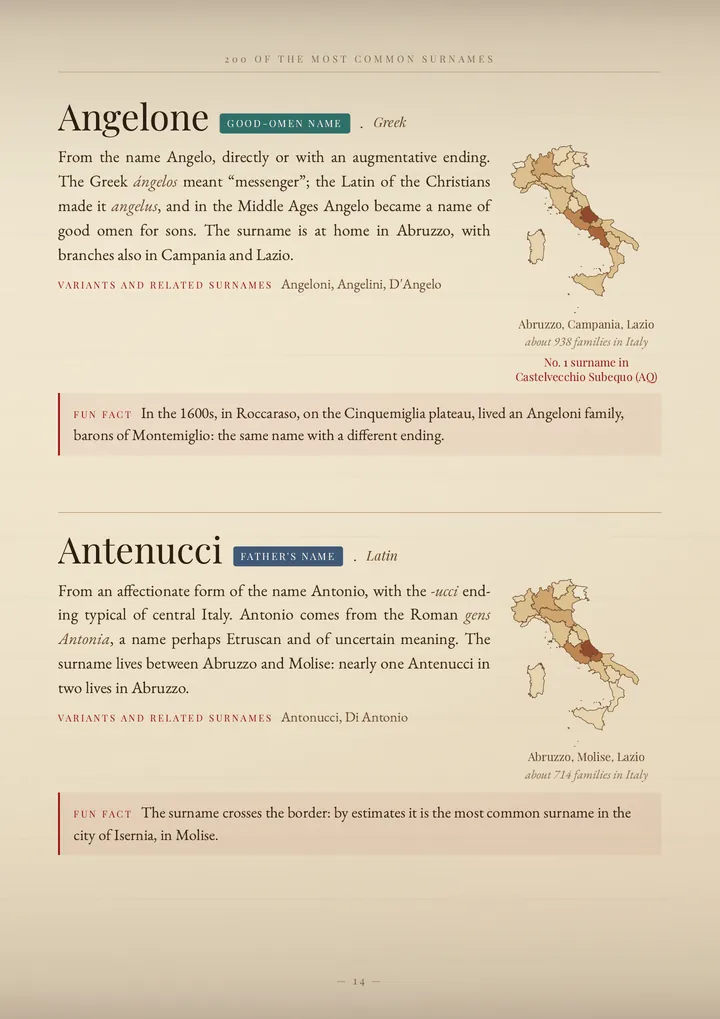
- For each surname, its origin, its meaning and the language it comes from, from Latin to the Germanic of the Lombards and the Franks, from the Greek of the saints to Spanish
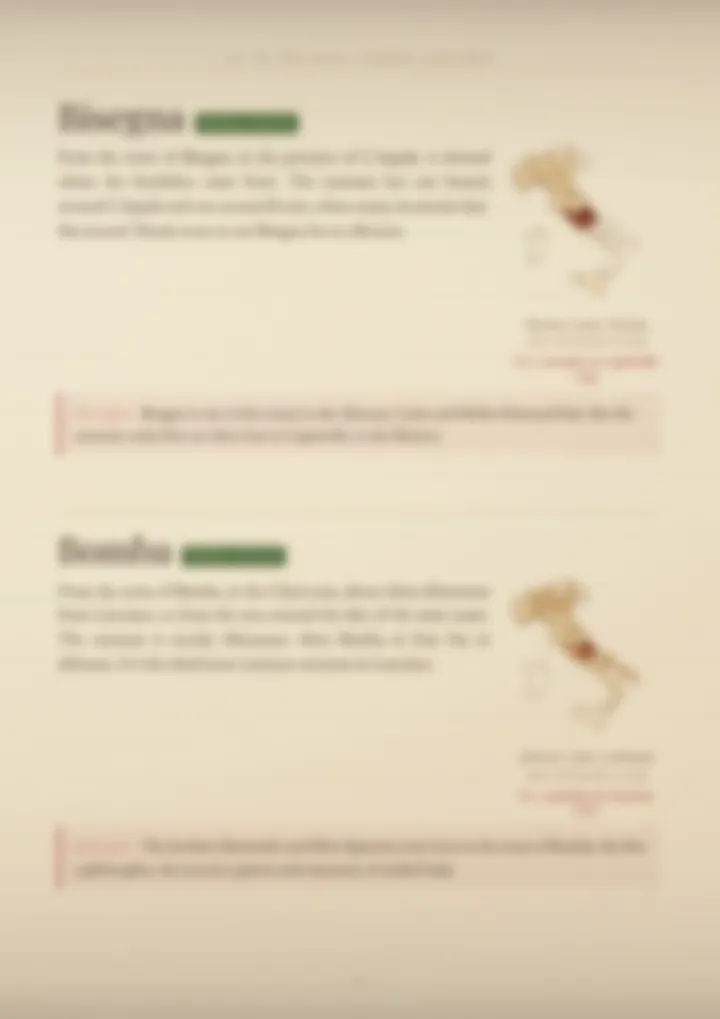
- The map of the Italian regions where it’s common today and an estimate of how many families carry it
- Where it stands in Abruzzo, when the figure exists, meaning its rank in Abruzzo or in the province, or the town where it ranks first
- The variants and related surnames, meaning the other forms and spellings of the same surname
- One fun fact per surname, from a town to a historical figure

Surnames of Abruzzo
Abruzzo’s surnames, people by people
Before Rome, the valleys of Abruzzo belonged to the Italic peoples: the Vestini, Marsi, Peligni, Marrucini, Frentani and Pretuzi. From the Pretuzi, who lived around Teramo, comes the medieval name of the region, Aprutium. In 90 BC they rebelled against Rome… continues in the volume
How to recognize an Abruzzo surname
In Abruzzo more than anywhere else, the surname came from the father’s name. That is why the region is full of Di, De and D’: Di Marco, Di Paolo, Di Giovanni, D’Alfonso, D’Orazio. Almost half of the 200 most common surnames in the book begin that way, and it… continues in the volume
Province by province
At the back of the volume an index gathers the surnames most common in each province. There are 255 surnames from the book, spread across the four provinces, Chieti, L’Aquila, Pescara and Teramo. Then comes the list of the 41 Abruzzo towns where a surname… continues in the volume
Is your surname in the volume?
Type it below: we'll tell you right away if it's there, and in which volume.
- Colantonio
- D’Ettorre
- Di Giacomo
- Capuani
- Colasante
- D’Eugenio
- Di Giamberardino
- De Vincentiis
- Di Giampaolo
- Consorti
- Di Antonio
- Di Giandomenico
- Angelone
- Carulli
- Di Bartolomeo
- Di Giovannantonio
- Antenucci
- Carusi
- Di Battista
- Di Giovanni
- Crisante
- Di Berardino
- Di Giulio
- Di Biase
- Di Giuseppe
- D’Adamo
- Di Blasio
- D’Ignazio
- Assogna
- D’Addario
- Di Bonaventura
- Di Lello
- D’Alberto
- Di Camillo
- Di Leonardo
- Centofanti
- D’Alfonso
- Di Campli
- Di Loreto
- Centorame
- D’Aloisio
- Di Carlo
- Di Luca
- D’Alonzo
- Di Cesare
- Di Luzio
- Bellisario
- D’Amario
- Di Clemente
- Di Marcantonio
- Berardinelli
- D’Annunzio
- Di Cola
- Di Marco
- Berardinucci
- D’Arcangelo
- Di Crescenzo
- Di Marzio
- Bisegna
- D’Ascanio
- Di Domizio
- Di Mattia
- Bomba
- Cianci
- De Amicis
- Di Egidio
- Di Michele
- De Berardinis
- Di Fabio
- Di Muzio
- Cicchini
- De Dominicis
- Di Febo
- Di Nella
- Buccella
- Cicchitti
- De Flaviis
- Di Federico
- Di Nicola
- De Laurentiis
- Di Felice
- D’Innocenzo
- Del Borrello
- Di Florio
- Di Nunzio
- Camaioni
- Dell’Elce
- Di Fonzo
- Candelori
- Cimini
- Del Monaco
- Di Francesco
- Diodato
- Candeloro
- Cipollone
- D’Emilio
- Di Pancrazio
- Cantagallo
- Cirone
- Di Gaetano
- Di Paolo
- Clementoni
- D’Eramo
- Di Genova
- Di Pietrantonio
- Caporale
- D’Ercole
- Di Giacinto
- Di Pietro
- Di Prinzio
- Forcella
- Malandra
- Paolone
- Di Renzo
- Fracassi
- Di Rocco
- Fuschi
- Di Sabatino
- Marchesani
- Pelusi
- Spadaccini
- Di Salvatore
- Persia
- Di Sante
- Piccirilli
- Di Saverio
- Galiffa
- Marcone
- Di Silvestre
- Marinucci
- Pierfelice
- Staniscia
- Di Teodoro
- Di Tullio
- Giammarco
- Marziani
- Polidoro
- Di Vincenzo
- Giammarino
- Di Virgilio
- Giampietro
- Pomponio
- Tenaglia
- Donatelli
- Giancola
- Masciarelli
- Tiberio
- D’Orazio
- Giancristofaro
- Presutti
- Toro
- D’Ottavio
- Giansante
- Masciulli
- Primavera
- D’Ovidio
- Ranalli
- Torrieri
- D’Urbano
- Guardiani
- Rapino
- Trabucco
- Faieta
- Iachini
- Travaglini
- Falone
- Fantauzzi
- Iacobucci
- Melchiorre
- Renzetti
- Ursini
- Fasciani
- Iannetti
- Vallese
- Iezzi
- Rocci
- Ventresca
- Febo
- Rulli
- Verna
- Feliciani
- Lanci
- Montebello
- Felicioni
- Salvatore
- Fidanza
- Leonzi
- Morgante
- Salvatorelli
- Zappacosta
- Finocchio
- Leonzio
- Narcisi
- Liberatore
- Saraceni
- Zinni
- Scarpone
- Zuccarini
- Florindi
- Zulli
- Agresta
- Caprioni
- Amicone
- Amicucci
- Carafa
- Consorte
- Ammazzalorso
- Caramanico
- Cordone
- Corneli
- Aquilano
- Casalena
- Artese
- Cavuto
- Crognale
- Ascenzo
- Cellini
- Cellucci
- Barnabei
- Centi
- Basciani
- Bellano
- Bellante
- Cerasa
- Cerasoli
- Ciampini
- Ciampoli
- Ciancarella
- Bonaduce
- Cicchinelli
- Brandimarte
- Buffone
- Ciccotosto
- Calista
- Cichetti
- Cicioni
- Diodati
- Di Fulvio
- De Nardis
- Capanna
- Colanero
- Silveri
- Marcanio
- Pasquarelli
- Sorgi
- Marcantonio
- Pellicciotta
- Spacca
- Fusella
- Fusilli
- Marchione
- Spezialetti
- Galeota
- Marchionne
- Spinosi
- Piccone
- Stanisci
- Gambacorta
- Gasbarro
- Marulli
- Pietrangelo
- Stante
- Stati
- Marzoli
- Pompa
- Stivaletta
- Masciantonio
- Porreca
- Mascioli
- Torricella
- Giardinelli
- Massimini
- Mastrocola
- Matricardi
- Raspa
- Iacoboni
- Medori
- Remigio
- Troilo
- Memmo
- Ricciuti
- Fattore
- Mirabilio
- Italiani
- Montaldi
- Sacchini
- Verrocchi
- Lemme
- Moretta
- Vitullo
- Santone
- Zavarella
- Firmani
- Paglione
- Flacco
- Libertini
- Palmitesta
- Luccitti
- Pantalone
- Sigismondi
The 10 most common surnames, in short
What they mean, in one sentence. The rest of the story is in the volume, and every surname has its own booklet.
- Di Marco
“Son of Marco.” The Latin name Marcus, perhaps linked to Mars, god of war, was among the most common in ancient Rome and stayed popular thanks to Saint Mark the Evangelist.
The full story of the Di Marco surname →- Di Pietro
“Son of Pietro.” From the nickname Jesus gave the apostle Simon: Pietro, Peter, “stone,” the rock on which to build the Church.
The full story of the Di Pietro surname →- Di Carlo
“Son of Carlo.” The name comes from the Germanic Karl, “free man,” and became famous with Charlemagne.
The full story of the Di Carlo surname →- Di Paolo
“Son of Paolo.” In Latin paulus means “small”: perhaps at first a nickname for the youngest child.
The full story of the Di Paolo surname →- Di Giovanni
“Son of Giovanni,” the best-loved name in Christendom, from the Hebrew “God has shown mercy.”
The full story of the Di Giovanni surname →- Di Giacomo
“Son of Giacomo.” Giacomo is the Italian form of Iacobus, that is Jacob: the name of two apostles and of the saint of Santiago de Compostela.
The full story of the Di Giacomo surname →- Di Francesco
“Son of Francesco.” The name spread everywhere thanks to Saint Francis of Assisi.
The full story of the Di Francesco surname →- Di Biase
“Son of Biase,” that is Biagio (Blaise).
The full story of the Di Biase surname →- Travaglini
There are two theories: from the Valtravaglia, in the Varese area, or from the medieval name Travalius, which appears in a deed of sale from Pavia in 1175. The surname is split in nearly equal parts between Abruzzo, the Marche and Lazio.
The full story of the Travaglini surname →- Iezzi
Probably from the biblical name Jesse, the father of King David, which in Hebrew means “gift.”
The full story of the Iezzi surname →
Frequently asked questions
Is my surname in the volume?
The full list of the 300 surnames is on this page. The full story of your surname, written for you, is in the €9.50 booklet on the “Your surname story” page.
How is it different from the volume on the South and the Islands?
The South volume picks 300 surnames from eight regions. This one is devoted to Abruzzo alone: eight chapters on the region’s peoples and stories and, when there is one, the place in Abruzzo where each surname ranks highest. 9 surnames are in both: the other 291 you’ll find only here.
Will I find the surnames of my province?
At the back of the volume an index gathers the surnames most common in each province. There are 255 surnames from the book, spread across Chieti, L’Aquila, Pescara and Teramo. There’s also the list of the 41 Abruzzo towns where a surname from the book is the most common.
What’s the difference between the volume and a surname booklet?
In the volume each surname has a half-page entry: origin, map, variants and a fun fact. The booklet is devoted to a single surname and tells its story, its towns and its distribution in 12-19 pages. It also has a family tree and a surname scroll personalized with that surname.
Does the volume tell me who my ancestors were?
No. A surname tells you where a word comes from, and two families with the same surname can have completely different stories. At the back of the volume there’s a guide to searching for your ancestors in the archives, free and from home. It includes tips for Abruzzo, where civil registration begins in 1809, when the region was part of the Kingdom of Naples: before that the parish priests kept the records.
Does the volume include my surname’s coat of arms?
No, because a surname has no coat of arms. A coat of arms belonged to one specific branch of a family, not to everyone who carries the surname. When a fun fact mentions one, the entry says which family it belonged to.
What if scholars disagree about the origin?
We tell you. When an origin is certain, it’s written as certain. When it isn’t, the entry carries the gray “disputed origin” badge and gives you the theories. For some extremely rare surnames that nobody has studied yet, the entry says exactly that.
Can I print it?
Yes, for personal and family use: you can print it for yourself and your relatives.
More volumes from the area
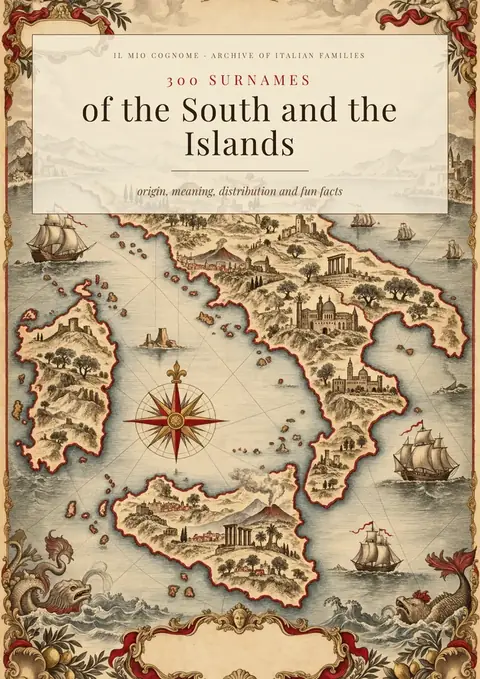 Surnames of the South and the Islands
Surnames of Abruzzo
Instant PDF · 176 pages
What people say about us
A few of the more than 20,000 comments and messages you’ve left us.
Read all the reviews