
Surnames of the Aosta Valley
origin, meaning, distribution and fun facts


€19.90 Instant PDF · 175 pages
Buy the volumeOne-time payment, no renewals · Secured by Stripe
- Instant PDF, and the link also arrives by email
- In Italian and English: you get both versions
- A4 format: read it on your phone or print it
In the Aosta Valley surnames look French and have cousins across the Alps: Favre is the blacksmith, Blanc is “white,” Brunod comes from Bruno, Bionaz from a village in the Valpelline. For centuries the valley spoke Franco-Provençal, the patois, from the same family of languages as Savoy and French-speaking Switzerland, and many surnames end in -az and -oz, with a z you don’t pronounce.
300surnames
175pages
9history chapters
What’s inside
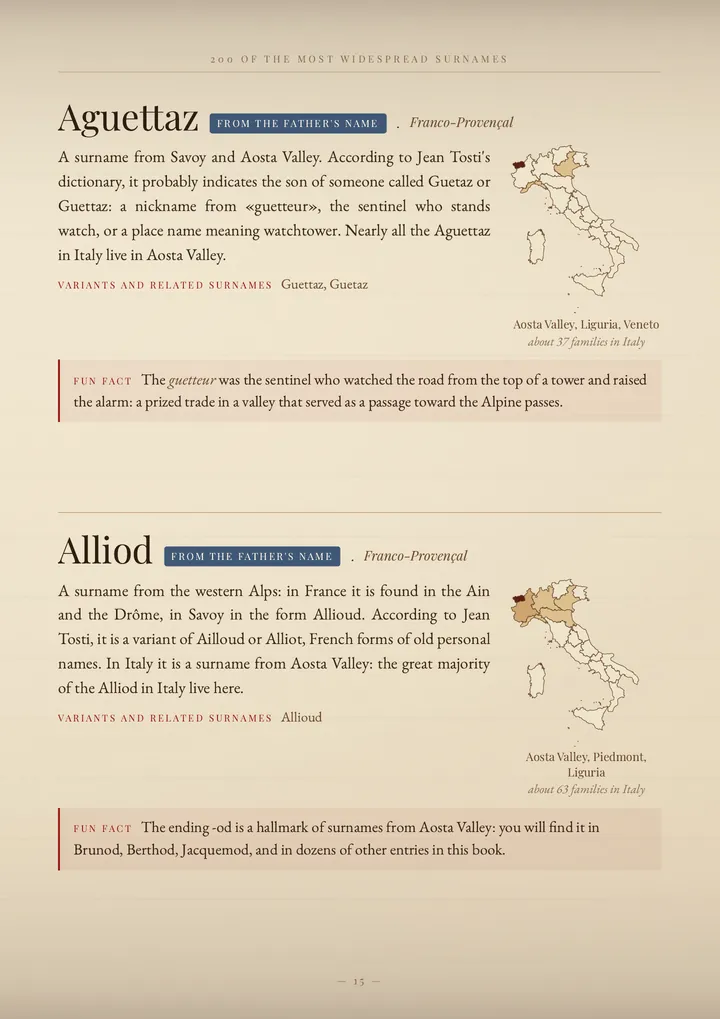
- For each surname, its origin, its meaning and the language it comes from, from the Franco-Provençal of the valleys to the German of the Walser
- The map of the Italian regions where it’s common today and an estimate of how many families carry it
- Where the surname ranks in the Aosta Valley, when there is a ranking: its place in the region, or the town where it ranks first or among the first
- The variants and related surnames, meaning the other forms and spellings of the same surname
- One fun fact per surname, from a town to a word of the old patois
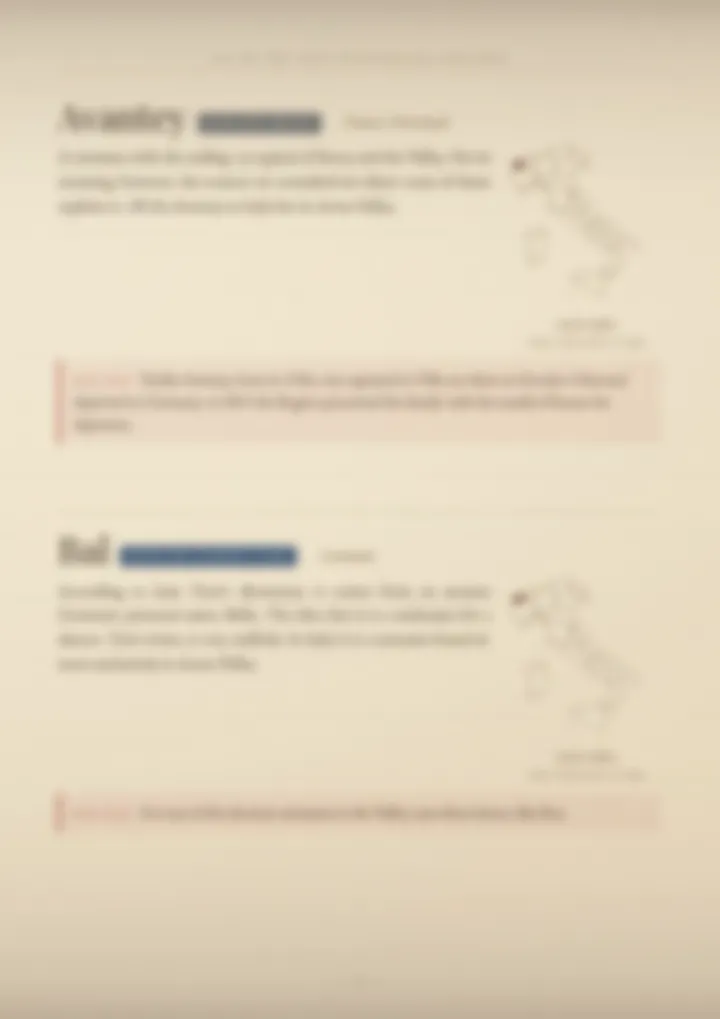

Surnames of the Aosta Valley
The Aosta Valley’s surnames, people by people
Before the Romans the valley belonged to the Salassi, a mountain people who controlled the passes and the gold mines of the Dora. In 25 BC the Romans defeated them and founded Augusta Praetoria, today’s Aosta. Latin words still hide inside the surnames:… continues in the volume
How to recognize an Aosta Valley surname
Some signs are easy to spot. The z at the end, which you don’t pronounce: Marguerettaz, Curtaz, Vuillermoz, Diemoz. It isn’t a sound, Treccani explains: it’s a mark that notaries and scribes used to French put at the end to show that the stress falls on the… continues in the volume
Town by town
At the back of the volume you’ll find the list of the 12 Aosta Valley towns where a surname from the book is the most common: in Ayas, for example, No. 1 is Favre, and in Cogne it is Gerard. Next come the surnames grouped by origin, from Franco-Provençal to… continues in the volume
Is your surname in the volume?
Type it below: we'll tell you right away if it's there, and in which volume.
- Aguettaz
- Alliod
- Ansermin
- Artaz
- Avantey
- Bal
- Bancod
- Barailler
- Barmasse
- Barmaverain
- Belley
- Berard
- Berlier
- Berthod
- Besenval
- Betemps
- Bethaz
- Bianquin
- Bich
- Binel
- Bionaz
- Bizel
- Blanc
- Blanchod
- Boch
- Bois
- Borbey
- Bordet
- Borettaz
- Borney
- Bosonetto
- Bosonin
- Bredy
- Brulard
- Brunet
- Brunier
- Brunod
- Camos
- Carrel
- Cerise
- Chabloz
- Chabod
- Challancin
- Chamonin
- Chanoine
- Chanoux
- Chapellu
- Charrere
- Charrey
- Charruaz
- Chasseur
- Chatel
- Chatrian
- Chaussod
- Cheillon
- Chenal
- Cheney
- Chenuil
- Cheraz
- Chevrier
- Christille
- Clappey
- Clerin
- Clos
- Colliard
- Come
- Comminet
- Consol
- Contoz
- Costabloz
- Courthoud
- Cout
- Cretaz
- Cretier
- Cuaz
- Cuneaz
- Curtaz
- Dagnes
- Dalbard
- Daudry
- Davisod
- Dayne
- Desandre
- Desaymonet
- Diemoz
- Domaine
- Donnet
- Donzel
- Dublanc
- Ducly
- Dufour
- Duguet
- Dujany
- Duroux
- Empereur
- Farcoz
- Favre
- Follien
- Foretier
- Fosson
- Foudon
- Foy
- Fruttaz
- Gaillard
- Gal
- Gaspard
- Gerard
- Gerbore
- Girod
- Glarey
- Gontel
- Gontier
- Gorret
- Grange
- Grivon
- Grosjacques
- Guichardaz
- Gyppaz
- Henriet
- Herin
- Hugonin
- Imperial
- Jaccod
- Jacquemod
- Jacquin
- Janin
- Jans
- Jeantet
- Joly
- Jordan
- Juglair
- Lale
- Laurent
- Lazier
- Letey
- Lettry
- Lillaz
- Linty
- Luboz
- Lucianaz
- Machet
- Maquignaz
- Marcoz
- Marguerettaz
- Martinet
- Martinod
- Merivot
- Meynet
- Millet
- Milliery
- Montrosset
- Munier
- Nieroz
- Paillex
- Pallais
- Peaquin
- Pellissier
- Perret
- Perrin
- Perron
- Personnettaz
- Pession
- Petey
- Petitjacques
- Petroz
- Pinet
- Porliod
- Pramotton
- Praz
- Proment
- Quendoz
- Quinson
- Rean
- Revil
- Rey
- Rolland
- Rollandin
- Ronc
- Roux
- Sarteur
- Savin
- Seguin
- Seris
- Stevenin
- Thiebat
- Truc
- Usel
- Vairos
- Vallet
- Vallomy
- Vassoney
- Vercellin
- Verthuy
- Vicquery
- Vierin
- Vigon
- Vittaz
- Voyat
- Vuillermin
- Vuillermoz
- Andruet
- Arvat
- Barell
- Barmaz
- Barrel
- Bataillon
- Baudin
- Beneyton
- Berriat
- Berthet
- Bieler
- Blanchet
- Bollon
- Bondon
- Bonel
- Borroz
- Bosc
- Bovet
- Brocard
- Brunodet
- Buat
- Buillet
- Chadel
- Chamonal
- Champion
- Champurney
- Champvillair
- Charbonnier
- Charles
- Charriere
- Charvet
- Chuc
- Clusaz
- Collomb
- Cornaz
- Coronel
- Crestaz
- Creton
- Deanoz
- Deval
- D’Herin
- Droz
- Duclos
- Dunoyer
- Engaz
- Farys
- Fassin
- Fey
- Fiou
- Follioley
- Frassy
- Gard
- Garin
- Gerbelle
- Grappein
- Grimod
- Guyon
- Haudemand
- Inconnu
- Jacquemet
- Jocallaz
- Jordaney
- Jotaz
- Junod
- Laffranc
- Lavevaz
- Lavoyer
- Leveque
- Lustrissy
- Magnin
- Magot
- Marquis
- Merlet
- Mochet
- Mondet
- Muin
- Obert
- Ottin
- Ottoz
- Philippot
- Piccot
- Pivot
- Rollandoz
- Rosaire
- Roullet
- Ruffier
- Savioz
- Savoye
- Squindo
- Squinobal
- Thuegaz
- Tillier
- Truchet
- Tutel
- Ussin
- Vacher
- Vauthier
- Viot
- Voulaz
- Yoccoz
The 10 most common surnames, in short
What they mean, in one sentence. The rest of the story is in the volume, and every surname has its own booklet.
- Blanc
It means “white”: it was a nickname for someone with fair hair, a white beard, or light skin.
The full story of the Blanc surname →- Favre
It means “blacksmith”: it is the Savoy and Aosta Valley form of Fabre.
The full story of the Favre surname →- Perron
It comes from Pietro, Pierre: Treccani cites it as an example of an Aosta Valley surname born from a given name.
The full story of the Perron surname →- Cerise
Disputed origin. It may come from the French cerise, “cherry,” or from cerisier, “cherry tree.”
The full story of the Cerise surname →- Brunet
A diminutive of brun, “dark”: it was the nickname of someone with dark hair or a dark complexion.
The full story of the Brunet surname →- Pession
Its meaning has yet to be discovered: perhaps a place name, but this has not been proven.
The full story of the Pession surname →- Vuillermoz
According to Jean Tosti, it is a variant of the name Guillaume, Guglielmo, found in Savoy and Franche-Comté.
The full story of the Vuillermoz surname →- Joly
From the adjective joli, which in the Middle Ages did not mean “pretty” but “cheerful, joyful”.
The full story of the Joly surname →- Roux
It means “red”: it was the nickname for someone with red hair.
The full story of the Roux surname →- Bordet
A diminutive of borde, an Old French word for a small farm, a smallholding: Bordet was “the one from the little country house.”
The full story of the Bordet surname →
Frequently asked questions
Is my surname in the volume?
The full list of the 300 surnames is on this page. The full story of your surname, written for you, is in the €9.50 booklet on the “Your surname story” page.
How is it different from the volume on Northern Italy?
The Northern Italy volume picks 300 surnames from eight regions. This one is devoted to the Aosta Valley alone: nine chapters on the region’s peoples and stories and, when there is one, where each surname ranks in the valley. 7 surnames are in both: the other 293 you’ll find only here.
Will I find the surnames of my town?
At the back of the volume there’s the list of the 12 Aosta Valley towns where a surname from the book is the most common. The surnames are also grouped by origin, and there’s an alphabetical list of all 300.
What’s the difference between the volume and a surname booklet?
In the volume each surname has a half-page entry: origin, map, variants and a fun fact. The booklet is devoted to a single surname and tells its story, its towns and its distribution in 12-19 pages, with a family tree and a surname scroll personalized with that surname.
Does the volume tell me who my ancestors were?
No. A surname tells you where a word comes from, and two families with the same surname can have completely different stories. At the back of the volume there’s a guide to start searching for your ancestors in the archives, free and from home, with tips for the Aosta Valley, where civil registration arrived under Napoleon in 1806 and Italian civil registration began in 1866.
Does the volume include my surname’s coat of arms?
No, because a surname has no coat of arms: a coat of arms belonged to one specific branch of a family, not to everyone who carries the surname. When a fun fact mentions one, the entry says which family it belonged to.
What if scholars disagree about the origin?
We tell you. When an origin is certain, it’s written as certain; when it isn’t, the entry carries the gray “disputed origin” badge and gives you the theories.
Can I print it?
Yes, for personal and family use: you can print it for yourself and your relatives.
More volumes from the area
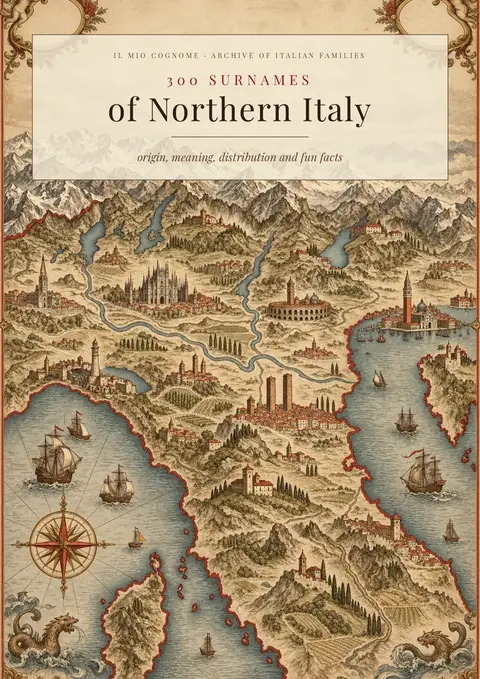 Surnames of Northern Italy
Surnames of the Aosta Valley
Instant PDF · 175 pages
What people say about us
A few of the more than 20,000 comments and messages you’ve left us.
Read all the reviews