
Surnames of Apulia
origin, meaning, distribution and fun facts


€19.90 Instant PDF · 179 pages
Buy the volumeOne-time payment, no renewals · Secured by Stripe
- Instant PDF, and the link also arrives by email
- In Italian and English: you get both versions
- A4 format: read it on your phone or print it
Apulia has spoken Messapic, Greek and Latin, and in a few towns people still speak Griko, old Albanian and Franco-Provençal. The settlers from Sparta at Taranto, the Byzantines at Bari, Normans, Swabians, the Saracens of Lucera, Angevins, Albanians and Spaniards: every people that passed through left something in the surnames families still carry today.
300surnames
179pages
11history chapters
What’s inside
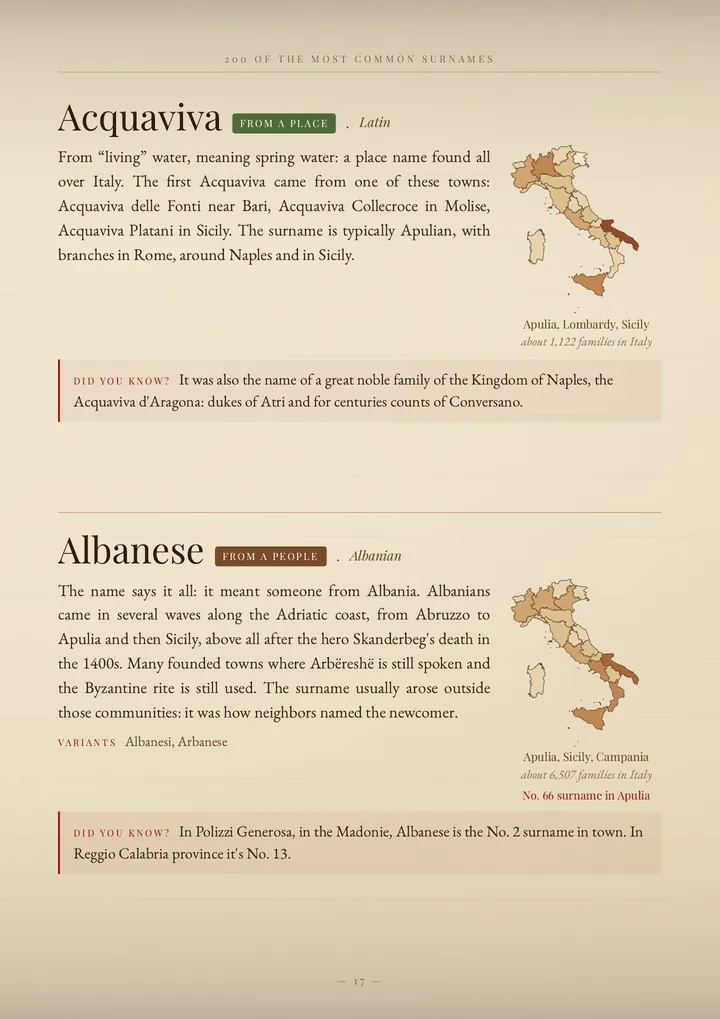
- For each surname, its origin, its meaning and the language it comes from, from Greek to Germanic to Albanian
- The map of the regions where it’s common today and an estimate of how many families carry it in Italy
- The Apulian record, when there is one: its rank in Apulia or in the province, or the town where it’s No. 1
- The variants of the surname and a fun fact, from an old document to a historical figure
- Eleven chapters on the peoples who shaped Apulian surnames, from the Messapians to the Spanish

Surnames of Apulia
Apulia’s surnames, people by people
Before the Greeks and the Romans, Apulia was the land of the Iapygians: the Daunians around Foggia, the Peucetians in the Bari area, the Messapians in the Salento. The Romans called it Apulia, and from there comes the surname Pugliese. Taranto, founded… continues in the volume
How to recognize an Apulian surname
Some signs are easy to spot. Around Bari the article got attached to the surname: Lorusso, Losito, Loconte, Labianca. In the Salento De dominates: De Giorgi, De Pascalis, De Santis. Many surnames are names of Apulian towns, like Altamura, Monopoli,… continues in the volume
Province by province
At the back of the volume an index gathers, province by province, the surnames most common there: 218 surnames from the book, spread across the six provinces from Bari to Taranto. Then comes the list of the 61 Apulian towns where a surname from the book is… continues in the volume
Is your surname in the volume?
Type it below: we'll tell you right away if it's there, and in which volume.
- Acquaviva
- Albanese
- Albano
- Altamura
- Amato
- Amoruso
- Ancona
- Antonacci
- Barletta
- Barone
- Basile
- Battista
- Bello
- Berardi
- Bianco
- Binetti
- Blasi
- Bruno
- Bucci
- Calabrese
- Calò
- Campanale
- Campanella
- Cannone
- Capone
- Caputo
- Caramia
- Carbonara
- Carbone
- Carella
- Carlucci
- Carluccio
- Carone
- Carrieri
- Carrozzo
- Cassano
- Castellano
- Catalano
- Cavallo
- Cazzato
- Centonze
- Ciavarella
- Clemente
- Colella
- Colonna
- Colucci
- Conte
- Coppola
- Curci
- D’Agostino
- D’Alessandro
- D’Amato
- D’Ambrosio
- D’Amico
- De Carlo
- De Giorgi
- D’Elia
- Dell’Anna
- De Luca
- Del Vecchio
- De Marco
- De Matteis
- De Palma
- De Pascalis
- D’Errico
- De Santis
- Di Bari
- Di Gioia
- Di Leo
- Elia
- Epifani
- Errico
- Esposito
- Falcone
- Fanelli
- Fasano
- Ferrante
- Ferrara
- Fiore
- Fiorentino
- Forte
- Fortunato
- Franco
- Gallo
- Gentile
- Giannuzzi
- Gigante
- Giordano
- Giuliani
- Grassi
- Grasso
- Greco
- Guerra
- Guglielmi
- Guida
- Ingrosso
- Laterza
- Leo
- Leone
- Ligorio
- Lippolis
- Liuzzi
- Lombardi
- Longo
- Lorusso
- Losito
- Macchia
- Maggi
- Maggio
- Maiorano
- Manca
- Mancini
- Manco
- Marangi
- Mariano
- Marinelli
- Marino
- Marra
- Martella
- Martina
- Martino
- Marzo
- Massaro
- Matera
- Mazzotta
- Mele
- Miccoli
- Miglietta
- Monaco
- Mongelli
- Monopoli
- Montanaro
- Orlando
- Pace
- Pagano
- Pagliara
- Palazzo
- Palma
- Palmieri
- Palmisano
- Palumbo
- Panico
- Paparella
- Paradiso
- Parisi
- Pastore
- Patruno
- Pellegrino
- Pepe
- Perrone
- Petrelli
- Pinto
- Potenza
- Prencipe
- Pugliese
- Putignano
- Ranieri
- Renna
- Resta
- Ricci
- Rinaldi
- Rizzello
- Rizzi
- Rizzo
- Rollo
- Romano
- Rosato
- Rubino
- Ruggieri
- Ruggiero
- Russo
- Rutigliano
- Santoro
- Saponaro
- Saracino
- Sasso
- Savino
- Scarano
- Schiavone
- Scialpi
- Semeraro
- Serio
- Spagnolo
- Spedicato
- Spinelli
- Stefanelli
- Tarantino
- Todisco
- Toma
- Tondo
- Totaro
- Tricarico
- Urso
- Valentini
- Ventura
- Vinci
- Vitale
- Volpe
- Zaccaria
- Zecca
- Accogli
- Aghilar
- Amatulli
- Antenozio
- Armenise
- Baldaro
- Bellanova
- Bottalico
- Bramato
- Buccoliero
- Buonpensiero
- Cagnazzo
- Calamita
- Caliandro
- Calogiuri
- Caponio
- Carbotti
- Castrignano
- Chimienti
- Chiriatti
- Ciardo
- Ciccarese
- Ciciriello
- Cinquepalmi
- Civita
- Colazzo
- Colizzi
- Convertini
- Convertino
- Corvaglia
- Cupertino
- Dibenedetto
- Donno
- Favia
- Ferrulli
- Francioso
- Giannoccaro
- Giorgino
- Gorgoglione
- Iacobellis
- Ieva
- Imperio
- Intini
- Labianca
- Ladisa
- Laghezza
- Lanotte
- Lauriola
- Lecce
- Lenoci
- Liso
- Loconte
- Locorotondo
- Loiudice
- Loparco
- Losurdo
- Manigrasso
- Mannarini
- Manzari
- Marzulli
- Massafra
- Matarrese
- Miccolis
- Montinaro
- Montrone
- Moramarco
- Morciano
- Morleo
- Motolese
- Muci
- Natola
- Nestola
- Netti
- Ninni
- Padalino
- Pennetta
- Petrachi
- Piccinno
- Pichierri
- Polieri
- Polimeno
- Quartulli
- Raguso
- Raho
- Rampino
- Ricchiuto
- Scardigno
- Schirinzi
- Schirone
- Schito
- Sgaramella
- Signorile
- Soldano
- Specchia
- Susca
- Tanzarella
- Tatullo
- Tramacere
- Tundo
- Zizzi
The 10 most common surnames, in short
What they mean, in one sentence. The rest of the story is in the volume, and every surname has its own booklet.
- Greco
“The Greek”: someone from Greece, or someone living in the southern communities that had spoken Greek for centuries.
The full story of the Greco surname →- Leone
From the name Leone (lion), loved in the Middle Ages for the animal’s strength and for the many saints and popes who bore it.
The full story of the Leone surname →- Santoro
From the medieval name Santorus, tied to Sanctorum Omnium, All Saints: the name of children born around November 1.
The full story of the Santoro surname →- Longo
“The long one”: the nickname of a tall or very thin man.
The full story of the Longo surname →- Gentile
From the Latin gentilis, “of the same people, the same lineage.”
The full story of the Gentile surname →- Leo
From the medieval name Leo, that is Leone, borne by popes, Byzantine emperors and saints.
The full story of the Leo surname →- Caputo
From Latin caput, the head. It was the nickname of someone with a big head, or someone very stubborn, a “capatosta,” a hard head.
The full story of the Caputo surname →- Perrone
From the medieval name Perrone, a form of Pietro: “big Peter.”
The full story of the Perrone surname →- Pinto
From Latin pinctus, “painted”: the nickname of someone with dark or mottled skin, for example from freckles, or of a painter.
The full story of the Pinto surname →- Calabrese
It meant someone from Calabria. But careful: in Byzantine times the name “Calabria” meant the Salento, the Lecce peninsula.
The full story of the Calabrese surname →
Frequently asked questions
Is my surname in the volume?
The full list of the 300 surnames is on this page. The full story of your surname, written for you, is in the €9.50 booklet on the “Your surname story” page.
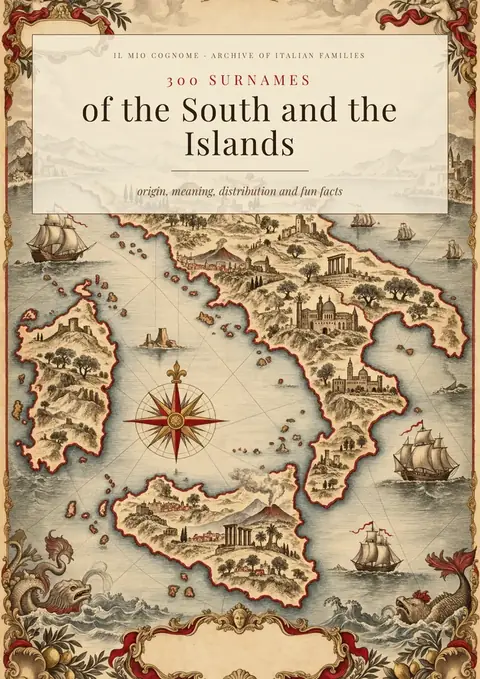
How is it different from the volume on the South and the Islands?
The South volume picks 300 surnames from eight regions. This one is devoted to Apulia alone: eleven chapters on the region’s peoples and stories and, when there is one, each surname’s Apulian record. 83 surnames are in both: the other 217 you’ll find only here.
Will I find the surnames of my province?
At the back of the volume an index gathers, province by province, the surnames most common there: 218 surnames from the book, spread across the six provinces from Bari to Taranto, Barletta-Andria-Trani included. There’s also the list of the 61 Apulian towns where a surname from the book is the most common.
What’s the difference between the volume and a surname booklet?
In the volume each surname has a half-page entry: origin, map, variants and a fun fact. The booklet is devoted to a single surname and tells its story, its towns and its distribution in 12-19 pages, with a family tree and a surname scroll personalized with that surname.
Does the volume tell me who my ancestors were?
No. A surname tells you where a word comes from, and two families with the same surname can have completely different stories. At the back of the volume there’s a guide to start searching for your ancestors in the archives, free and from home.
Does the volume include my surname’s coat of arms?
No, because a surname has no coat of arms: a coat of arms belonged to one specific branch of a family, not to everyone who carries the surname. When a fun fact mentions one, the entry says which family it belonged to.
Can I print it?
Yes, for personal and family use: you can print it for yourself and your relatives.
 Surnames of Bari
 Surnames of the South and the Islands
Surnames of Apulia
Instant PDF · 179 pages
What people say about us
A few of the more than 20,000 comments and messages you’ve left us.
Read all the reviews