
Surnames of Basilicata
origin, meaning, distribution and fun facts


€19.90 Instant PDF · 178 pages
Buy the volumeOne-time payment, no renewals · Secured by Stripe
- Instant PDF, and the link also arrives by email
- In Italian and English: you get both versions
- A4 format: read it on your phone or print it
Before Rome, this land belonged to the Lucanians, and on the Ionian coast the cities of the Greeks already stood. Then came the Byzantine monks, the Lombards, the Normans and Frederick II, the settlers from the north whom people here called Lombards, and the Albanian arbëreshë, and every story left something in the surnames. Colangelo and Iacovino come from the names of fathers, Brienza and Stigliano from towns, Laguardia and Labanca from nicknames whose article stuck to the word.
300surnames
178pages
10history chapters
What’s inside
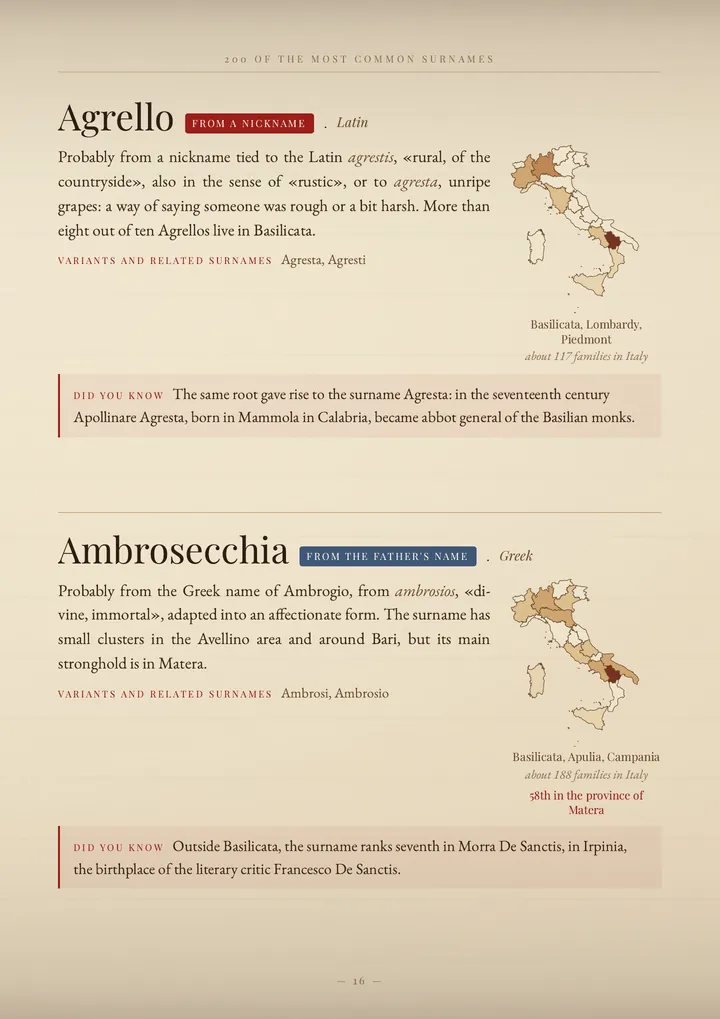
- For each surname, its origin, its meaning and the language it comes from, from Latin and Greek to the Germanic of the Lombards, from the French of the Normans to Albanian
- The map of the Italian regions where it’s common today and an estimate of how many families carry it
- Where it stands in Basilicata, when the figure exists, meaning its rank in Basilicata or in the province, or the town where it ranks first
- The variants and related surnames, meaning the other forms and spellings of the same surname
- One fun fact per surname, from a town to a historical figure
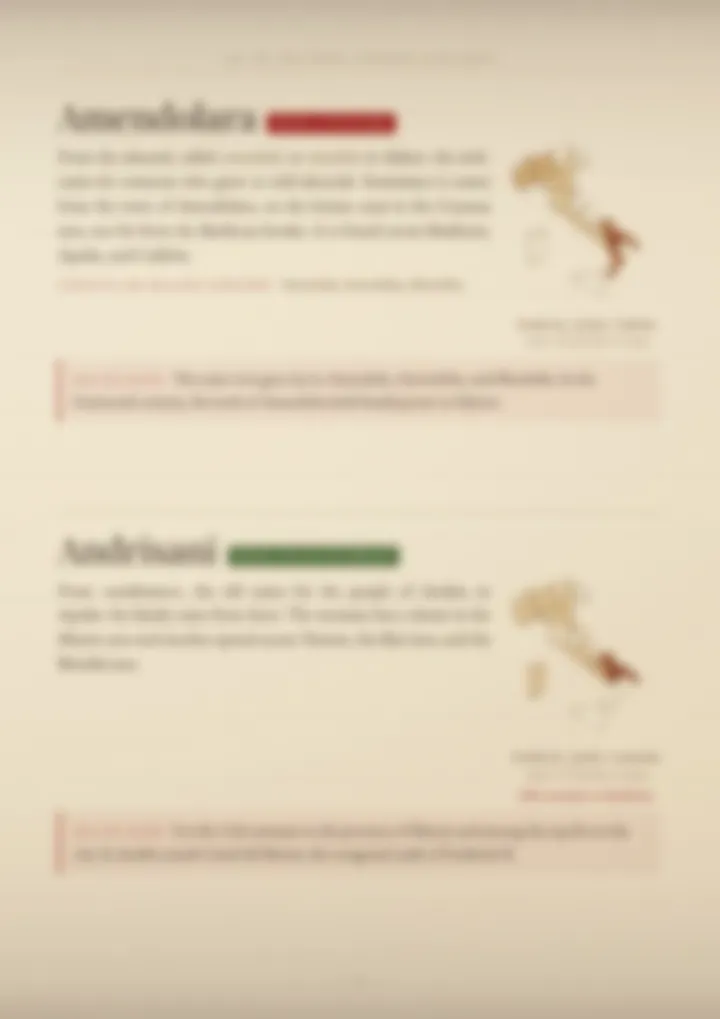

Surnames of Basilicata
Basilicata’s surnames, people by people
Before Rome, this land belonged to the Lucanians, an Oscan-speaking people who came down from the mountains around the 5th century BC. On the Ionian coast the cities of the Greeks already stood: Metaponto, Siris, Heraclea. In 291 BC Rome founded the colony… continues in the volume
How to recognize a Lucanian surname
Some signs are easy to spot. In Basilicata many surnames stayed in the singular, as in the rest of the South: Romaniello, not Romanielli. But there are plenty in -i too, like Carlucci or Gesualdi. The pet endings are -iello, -illo and -icchio: Bochicchio,… continues in the volume
Province by province
At the back of the volume an index gathers the surnames most common in each province. There are 224 surnames from the book, spread across the two provinces, Matera and Potenza. Then comes the list of the 42 Lucanian towns where a surname from the book is the… continues in the volume
Is your surname in the volume?
Type it below: we'll tell you right away if it's there, and in which volume.
- Agrello
- Ambrosecchia
- Amendolara
- Andrisani
- Arcieri
- Armentano
- Auletta
- Bellusci
- Benevento
- Biscione
- Bochicchio
- Borraccia
- Brando
- Brienza
- Caggianese
- Caivano
- Calciano
- Camardo
- Cancellara
- Cancelliere
- Capece
- Carlomagno
- Carlucci
- Carriero
- Cassino
- Castelluccio
- Castronuovo
- Catarinella
- Cavuoti
- Celano
- Cerone
- Cifarelli
- Cirigliano
- Coiro
- Colangelo
- Corleto
- Coronato
- Coviello
- D’Amelio
- Danzi
- D’Aria
- Deufemia
- Di Ciommo
- Digilio
- Di Lascio
- Di Lecce
- Dimatteo
- Di Noia
- Di Stasi
- Di Taranto
- Di Tomaso
- Donadio
- Dragonetti
- Faliero
- Figliuolo
- Fittipaldi
- Forastiero
- Fulco
- Galgano
- Gallicchio
- Gammone
- Gaudiano
- Gesualdi
- Giacomino
- Gilio
- Giosa
- Giura
- Giuzio
- Grieco
- Grippo
- Gruosso
- Iacovino
- Iacovone
- Iannuzziello
- Iula
- Labanca
- Labella
- Labriola
- Lagrutta
- Laguardia
- Lamacchia
- Lamorte
- Lapadula
- Lapenta
- Lapolla
- Larocca
- Latorraca
- Latronico
- Laurino
- Laurita
- Lavecchia
- Laviano
- Laviola
- Limongi
- Lisanti
- Lista
- Locantore
- Lo Franco
- Logiurato
- Loguercio
- Lomonaco
- Lopardo
- Loperfido
- Losasso
- Lovaglio
- Lovallo
- Macellaro
- Malvasi
- Mancusi
- Manfreda
- Mango
- Manieri
- Manniello
- Maragno
- Marolda
- Marsicovetere
- Martoccia
- Masino
- Mastroberti
- Mastropierro
- Mastrosimone
- Mazzarelli
- Mazzucca
- Mecca
- Miglionico
- Moles
- Moliterni
- Montanarella
- Montano
- Montemurro
- Montesano
- Muro
- Muscillo
- Muscio
- Nicodemo
- Pacella
- Padula
- Pafundi
- Pansardi
- Paolicelli
- Papaleo
- Pennella
- Pergola
- Petrarulo
- Petrino
- Petrocelli
- Picerno
- Pietrafesa
- Possidente
- Potenza
- Puppio
- Quinto
- Ramunno
- Rivelli
- Riviello
- Romaniello
- Rondinone
- Russillo
- Sabato
- Sabia
- Salvia
- Sanchirico
- Sangiacomo
- Santarcangelo
- Santarsiero
- Santochirico
- Santopietro
- Saponara
- Sarubbi
- Sassano
- Sassone
- Satriano
- Scavone
- Schettini
- Scioscia
- Silletti
- Smaldone
- Soldo
- Solimando
- Spaltro
- Sperduto
- Stigliani
- Stigliano
- Stolfi
- Summa
- Tavolaro
- Telesca
- Tempone
- Teora
- Tito
- Trivigno
- Varallo
- Venezia
- Viceconte
- Viggiani
- Viggiano
- Vizziello
- Zaccagnino
- Zaccara
- Zotta
- Alagia
- Appio
- Barbarito
- Barbuzzi
- Bavuso
- Belluscio
- Berardone
- Berterame
- Bisaccia
- Brindisi
- Calvello
- Cantisani
- Capezzera
- Capolupo
- Carcuro
- Chietera
- Cisterna
- Cupparo
- Dalessandri
- Dambrosio
- D’Angella
- D’Armento
- De Canio
- De Giacomo
- De Mare
- Dichio
- Di Marsico
- Di Trani
- Eletto
- Epifania
- Errichetti
- Eufemia
- Farfariello
- Ferrandina
- Finiguerra
- Fuina
- Galotta
- Garramone
- Garzone
- Gaudioso
- Giuseffi
- Gulfo
- Gurrado
- Iannibelli
- Iannielli
- Ielpo
- Lacanna
- Laconca
- Laginestra
- Lamboglia
- Langone
- Lardo
- Larotonda
- Lasala
- Lasaponara
- Laurenzana
- Lavieri
- Lerose
- Libonati
- Linsalata
- Lioi
- Lobosco
- Logrippo
- Loisi
- Lopergolo
- Lospinuso
- Manicone
- Marchitiello
- Marsico
- Martinese
- Mastrolorenzo
- Melfi
- Mianulli
- Mitidieri
- Motola
- Nardozza
- Nolè
- Pettorruso
- Pietrantuono
- Racioppi
- Rasulo
- Ricciardulli
- Ricigliano
- Rienzi
- Roseti
- Sabatella
- Sarli
- Scalcione
- Scaldaferri
- Scelzo
- Sileo
- Sinisgalli
- Spennacchio
- Tolve
- Triunfo
- Urgo
- Verrastro
- Vizzuso
- Votta
- Zaccardo
The 10 most common surnames, in short
What they mean, in one sentence. The rest of the story is in the volume, and every surname has its own booklet.
- Colangelo
A surname that blends two names: Cola, the folk form of Nicola, and Angelo.
The full story of the Colangelo surname →- Padula
From a town such as Padula, in the Salerno area, or from a place near a swamp, from the Latin palus.
The full story of the Padula surname →- Coviello
Probably from the nickname of Coviello, the stock character of the folk theater of central and southern Italy: a crafty, fawning, and talkative servant.
The full story of the Coviello surname →- Montesano
From a nickname indicating someone who came from the mountains, or from a town like Montesano sulla Marcellana, in the Salerno area, or Montesano Salentino.
The full story of the Montesano surname →- Summa
Probably from a town like Somma Vesuviana or Massa di Somma, near Naples, or from another place with a similar name.
The full story of the Summa surname →- Montemurro
Probably from the town of Montemurro, in the province of Potenza: the first of the family came from there.
The full story of the Montemurro surname →- Telesca
Probably from Masseria Telesca, a hamlet of Pignola near Potenza, whose name may recall the ancient Samnite city of Telesia.
The full story of the Telesca surname →- Viggiano
From the town of Viggiano, in the Val d’Agri, whose name derives from the Latin Vigianus.
The full story of the Viggiano surname →- Sabia
Probably from the gens Sabia, an ancient Roman family widespread in Campania and Lucania.
The full story of the Sabia surname →- Romaniello
From an affectionate form of the Latin name Romanus, “Roman, born in Rome”, with the diminutive suffix -iello typical of the South.
The full story of the Romaniello surname →
Frequently asked questions
Is my surname in the volume?
The full list of the 300 surnames is on this page. The full story of your surname, written for you, is in the €9.50 booklet on the “Your surname story” page.
How is it different from the volume on the South and the Islands?
The South volume picks 300 surnames from eight regions. This one is devoted to Basilicata alone: ten chapters on the region’s peoples and stories and, when there is one, the place in Basilicata where each surname ranks highest. 4 surnames are in both: the other 296 you’ll find only here.
Will I find the surnames of my province?
At the back of the volume an index gathers the surnames most common in each province. There are 224 surnames from the book, spread across Matera and Potenza. There’s also the list of the 42 Lucanian towns where a surname from the book is the most common.
What’s the difference between the volume and a surname booklet?
In the volume each surname has a half-page entry: origin, map, variants and a fun fact. The booklet is devoted to a single surname and tells its story, its towns and its distribution in 12-19 pages. It also has a family tree and a surname scroll personalized with that surname.
Does the volume tell me who my ancestors were?
No. A surname tells you where a word comes from, and two families with the same surname can have completely different stories. At the back of the volume there’s a guide to searching for your ancestors in the archives, free and from home. It includes tips for Basilicata, where civil registration dates from 1809, when the region was part of the Kingdom of Naples.
Does the volume include my surname’s coat of arms?
No, because a surname has no coat of arms. A coat of arms belonged to one specific branch of a family, not to everyone who carries the surname. When a fun fact mentions one, the entry says which family it belonged to.
What if scholars disagree about the origin?
We tell you. When an origin is certain, it’s written as certain. When it isn’t, the entry carries the gray “disputed origin” badge and gives you the theories.
Can I print it?
Yes, for personal and family use: you can print it for yourself and your relatives.
More volumes from the area
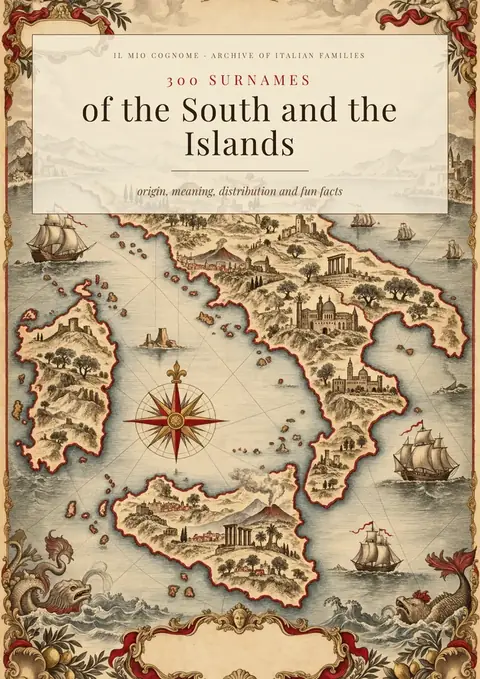 Surnames of the South and the Islands
Surnames of Basilicata
Instant PDF · 178 pages
What people say about us
A few of the more than 20,000 comments and messages you’ve left us.
Read all the reviews