
Surnames of Calabria
origin, meaning, distribution and fun facts


€19.90 Instant PDF · 179 pages
Buy the volumeOne-time payment, no renewals · Secured by Stripe
- Instant PDF, and the link also arrives by email
- In Italian and English: you get both versions
- A4 format: read it on your phone or print it
In Calabria the butcher was called Crea and the tall man Macrì: when surnames were born, many towns in the south of the region still spoke Greek. Then came Lombards, Arabs, Normans, Spaniards, Albanians: every people that passed through left something in the surnames families still carry today.
300surnames
179pages
11history chapters
What’s inside
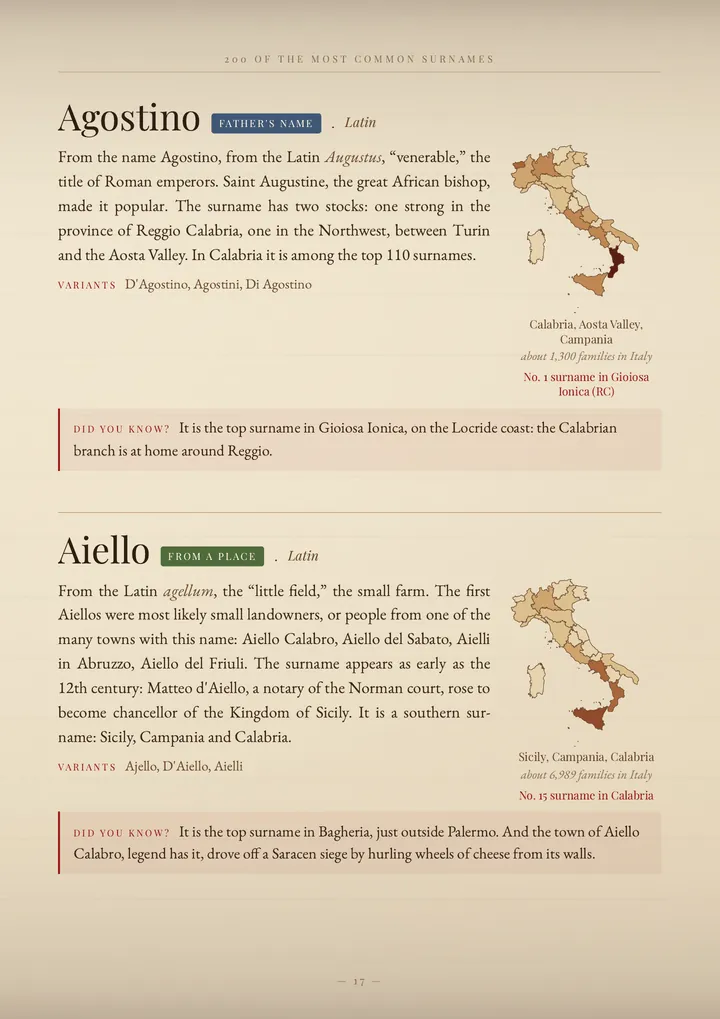
- For each surname, its origin, its meaning and the language it comes from, from Greek to Albanian
- The map of the regions where it’s common today, an estimate of how many families carry it and, when there is one, its record in Calabria
- The variants, meaning the dialect forms, the other spellings and the related surnames
- One fun fact per surname, from an old document to a town where it’s No. 1
- Eleven chapters on the peoples who shaped Calabrian surnames, from Magna Graecia to the Jews of Calabria
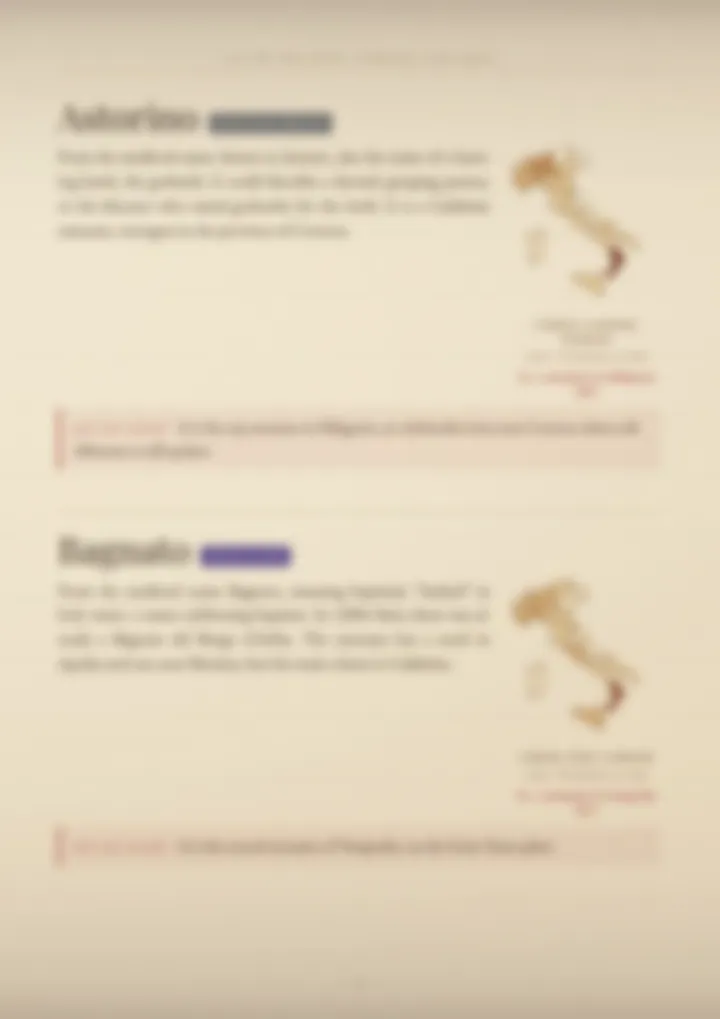

Surnames of Calabria
Calabria’s surnames, people by people
Before Rome, the Calabrian coast was Magna Graecia: Sibari, Crotone, Locri, Reggio. Greek did not disappear. It came back with the Byzantines, who ruled Calabria for five hundred years, and in many towns in the south of the region it was still the language… continues in the volume
How to recognize a Calabrian surname
Some signs are easy to spot. The accent at the end, as in Macrì, Laganà, Praticò and Sgrò, is almost always a clue to Greek. The endings -iti and -oti mean “the people of”: the Paviglianiti are the people of Pavigliana, the Chiaravalloti those of… continues in the volume
Province by province
At the back of the volume an index gathers, province by province, the surnames most common there: 207 surnames from the book, spread across the five provinces from Catanzaro to Vibo Valentia. Then comes the list of the 73 Calabrian towns where a surname from… continues in the volume
Is your surname in the volume?
Type it below: we'll tell you right away if it's there, and in which volume.
- Agostino
- Aiello
- Albanese
- Altomare
- Amato
- Amendola
- Arcuri
- Arena
- Astorino
- Bagnato
- Barberio
- Barbieri
- Barone
- Barreca
- Basile
- Battaglia
- Bianco
- Bilotta
- Bova
- Bruno
- Bruzzese
- Calabrese
- Calabretta
- Calabrò
- Caligiuri
- Capalbo
- Capparelli
- Caputo
- Caracciolo
- Carbone
- Caridi
- Carnevale
- Caruso
- Catalano
- Cavallaro
- Ceravolo
- Chiappetta
- Chirico
- Cimino
- Cipolla
- Cirillo
- Colosimo
- Corrado
- Cortese
- Cosentino
- Cosenza
- Costa
- Costantino
- Costanzo
- Cotroneo
- Cozza
- Crea
- Cristiano
- Critelli
- Curcio
- D’Agostino
- De Fazio
- De Luca
- De Marco
- De Rose
- De Simone
- Donato
- Durante
- Elia
- Esposito
- Fabiano
- Falbo
- Falcone
- Falvo
- Fazio
- Federico
- Ferraro
- Filice
- Filippelli
- Folino
- Forciniti
- Foti
- Franco
- Fusaro
- Gabriele
- Gagliardi
- Galati
- Gallo
- Garofalo
- Gatto
- Gaudio
- Gentile
- Gerace
- Giglio
- Gigliotti
- Giordano
- Giovinazzo
- Grande
- Grandinetti
- Graziano
- Greco
- Grillo
- Grosso
- Gualtieri
- Guido
- Guzzo
- Ianni
- Iaquinta
- Iaria
- Imbrogno
- Laganà
- Lamanna
- Latella
- Leone
- Lombardo
- Longo
- Macrì
- Madeo
- Maiolo
- Mancuso
- Manfredi
- Marasco
- Marchese
- Marino
- Marra
- Martino
- Mastroianni
- Mauro
- Mazza
- Mazzei
- Mazzeo
- Mazzitelli
- Mazzotta
- Mendicino
- Mercuri
- Mercurio
- Messina
- Miceli
- Minniti
- Mirabelli
- Molinaro
- Monteleone
- Morabito
- Morelli
- Morrone
- Muraca
- Musolino
- Napoli
- Nicoletti
- Oliva
- Orlando
- Pace
- Palermo
- Palmieri
- Panetta
- Parise
- Parisi
- Pellegrino
- Perri
- Perrone
- Pignataro
- Pisani
- Pisano
- Polimeni
- Porco
- Praticò
- Procopio
- Pucci
- Pugliese
- Ranieri
- Raso
- Reda
- Rizzo
- Rocca
- Romano
- Romeo
- Rotella
- Ruffolo
- Russo
- Sacco
- Santoro
- Sapia
- Scopelliti
- Sergi
- Serra
- Serratore
- Sgrò
- Siciliano
- Sirianni
- Sorrentino
- Spadafora
- Spanò
- Spina
- Sposato
- Surace
- Tedesco
- Toscano
- Tripodi
- Vaccaro
- Veltri
- Ventura
- Viola
- Vitale
- Zappia
- Zito
- Adornato
- Algieri
- Aloe
- Aloise
- Apa
- Aragona
- Audia
- Avato
- Baffa
- Barbalace
- Barilla
- Barillaro
- Belvedere
- Bloise
- Bonofiglio
- Bossio
- Brogno
- Canonaco
- Casile
- Cauteruccio
- Cerminara
- Cersosimo
- Chiaravalloti
- Cianflone
- Ciardullo
- Cofone
- Condemi
- Condoluci
- Corapi
- Corasaniti
- Corea
- Crugliano
- Crusco
- Curatola
- Curia
- Cutrupi
- De Grazia
- Dodaro
- Fazzolari
- Fortugno
- Fotia
- Fratto
- Gaccione
- Garcea
- Garreffa
- Guarascio
- Iaconis
- Iacovo
- Idone
- Ielo
- Iozzo
- Labonia
- Levato
- Librandi
- Lofaro
- Lo Giacco
- Macheda
- Macrina
- Madia
- Maradei
- Marrapodi
- Maruca
- Mellace
- Mesoraca
- Michienzi
- Modaffari
- Modafferi
- Nocito
- Occhiuzzi
- Papasidero
- Parrotta
- Paviglianiti
- Pitasi
- Plutino
- Pulice
- Rende
- Repaci
- Riccelli
- Riillo
- Ripepi
- Rombola
- Rovito
- Santagada
- Sapone
- Scarcello
- Scerbo
- Scigliano
- Scordo
- Siclari
- Solano
- Spizzirri
- Straface
- Strangis
- Stumpo
- Trapasso
- Tundis
- Vono
- Vulcano
- Vuono
- Zema
The 10 most common surnames, in short
What they mean, in one sentence. The rest of the story is in the volume, and every surname has its own booklet.
- Romeo
From Greek rhomaîos, “Roman.” In the Middle Ages the romeo was the pilgrim who went to Rome out of devotion, but the Byzantines also called themselves “Romans,” as they saw themselves as the true heirs of the Roman Empire.
The full story of the Romeo surname →- Pugliese
“The Apulian”: someone who came from Apulia, from Latin Apulia, the land of the Apuli.
The full story of the Pugliese surname →- De Marco
“Son of Marco,” or “of Marco’s family.” Marcus was among the most common names in ancient Rome; the Middle Ages revived it thanks to Saint Mark the Evangelist.
The full story of the De Marco surname →- Macrì
From the Greek makrýs, “long, tall,” or from the Latin macer, “thin.”
The full story of the Macrì surname →- Perri
It sounds Spanish, but there are three paths. A dialect form of Pietro. Spanish perro, “dog,” as an unkind nickname. Or Greek pyrrhós, “red-haired.” Scholars disagree. What is certain is that it is one of the most Calabrian surnames there is.
The full story of the Perri surname →- Morabito
From Arabic murābiṭ, the holy man, the man of faith who preached.
The full story of the Morabito surname →- Curcio
From a dialect nickname meaning “short”: the founder was probably short.
The full story of the Curcio surname →- Molinaro
From Late Latin molinarius, “mill worker”: a nickname for the miller, for someone who owned a mill or for a family living next to one.
The full story of the Molinaro surname →- Morrone
From a nickname tied to dark hair or skin, “the Moor,” or from places like Castel Morrone near Caserta or Morrone del Sannio in Molise.
The full story of the Morrone surname →- Fabiano
From the Latin Fabianus, “of the family of the Fabii,” one of the great families of ancient Rome.
The full story of the Fabiano surname →
Frequently asked questions
Is my surname in the volume?
The full list of the 300 surnames is on this page. The full story of your surname, written for you, is in the €9.50 booklet on the “Your surname story” page.
How is it different from the volume on the South and the Islands?
The South volume picks 300 surnames from eight regions. This one is devoted to Calabria alone: eleven chapters on the region’s peoples and stories and, when there is one, each surname’s Calabrian record. 79 surnames are in both: the other 221 you’ll find only here.
Will I find the surnames of my province?
At the back of the volume an index gathers, province by province, the surnames most common there: 207 surnames from the book, spread across the five provinces from Catanzaro to Vibo Valentia. There’s also the list of the 73 Calabrian towns where a surname from the book is the most common.
What’s the difference between the volume and a surname booklet?
In the volume each surname has a half-page entry: origin, map, variants and a fun fact. The booklet is devoted to a single surname and tells its story, its towns and its distribution in 12-19 pages, with a family tree and a surname scroll personalized with that surname.
Does the volume tell me who my ancestors were?
No. A surname tells you where a word comes from, and two families with the same surname can have completely different stories. At the back of the volume there’s a guide to start searching for your ancestors in the archives, free and from home, including for the branches that emigrated to America.
Does the volume include my surname’s coat of arms?
No, because a surname has no coat of arms: a coat of arms belonged to one specific branch of a family, not to everyone who carries the surname. When a fun fact mentions one, the entry says which family it belonged to.
Does the volume tell me which town my surname comes from?
When there is one, the red line under the map shows the Calabrian record: the surname’s rank in Calabria, or the town in the region where it’s No. 1 or near the top.
Can I print it?
Yes, for personal and family use: you can print it for yourself and your relatives.
More volumes from the area
 Surnames of Reggio Calabria
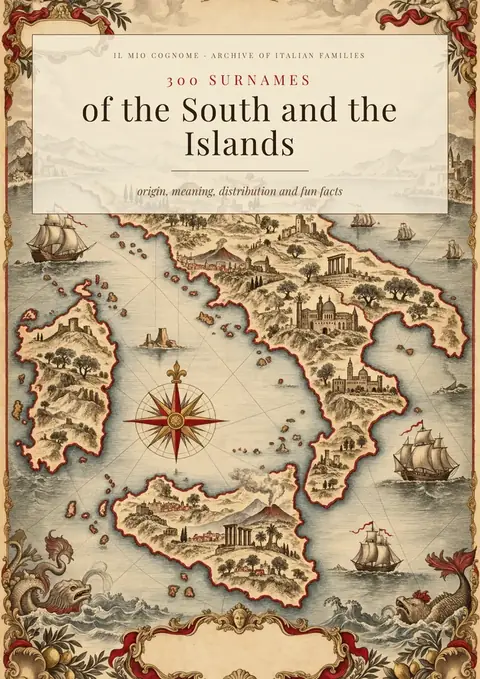 Surnames of the South and the Islands
Surnames of Calabria
Instant PDF · 179 pages
What people say about us
A few of the more than 20,000 comments and messages you’ve left us.
Read all the reviews