
Surnames of Emilia-Romagna
origin, meaning, distribution and fun facts


€19.90 Instant PDF · 176 pages
Buy the volumeOne-time payment, no renewals · Secured by Stripe
- Instant PDF, and the link also arrives by email
- In Italian and English: you get both versions
- A4 format: read it on your phone or print it
Emilia takes its name from a road, the Via Emilia the Romans built from Rimini to Piacenza. Romagna comes from Romania, “the land of the Romans,” the name the Lombards gave to the lands of the Byzantines of Ravenna. Etruscans and Celts, Lombards and Franks, the Este and the Farnese: every chapter of history that passed through here left something in the region’s surnames, and a great many are shortened names, like Zanni from Giovanni and Righi from Arrigo.
300surnames
176pages
8history chapters
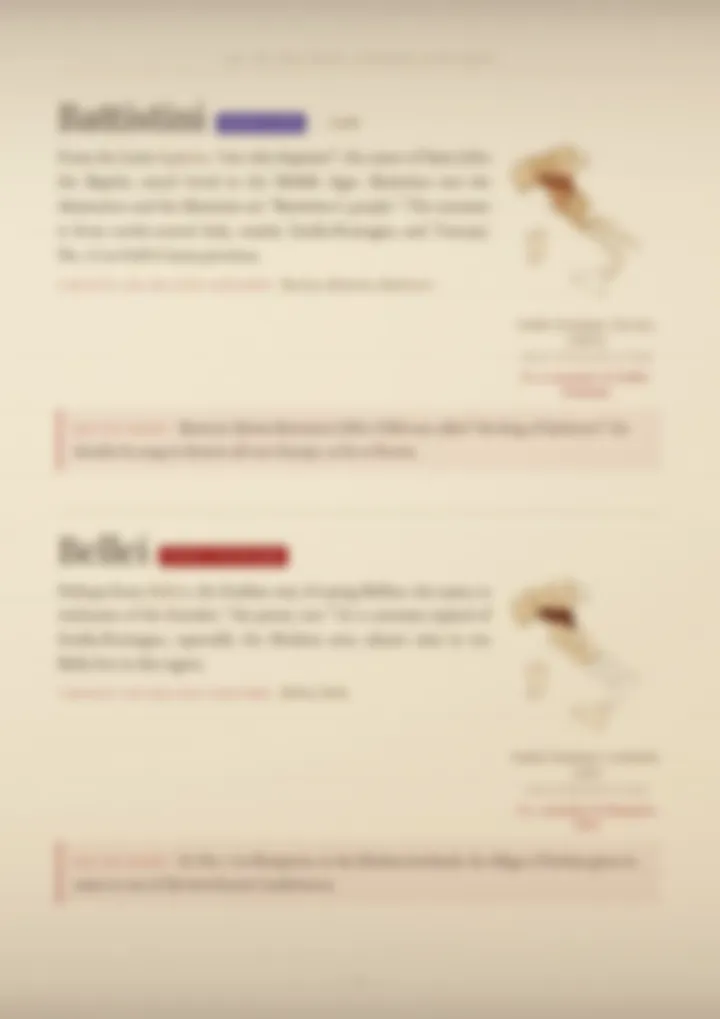
What’s inside
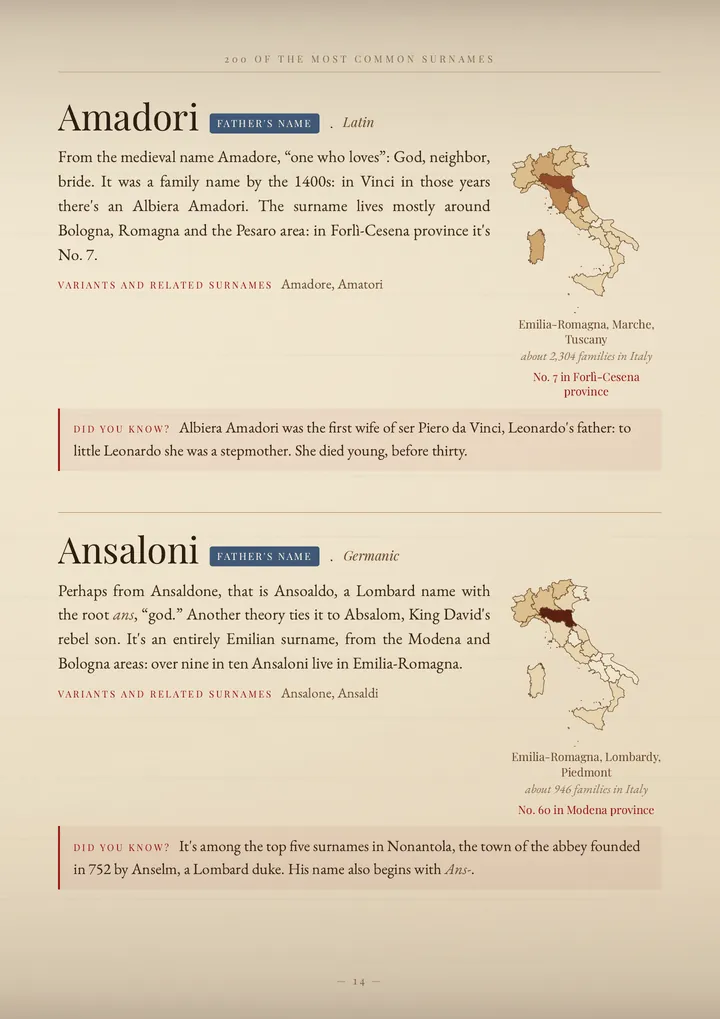
- For each surname, its origin, its meaning and the language it comes from, from Latin to the Germanic of the Lombards and the Franks
- The map of the Italian regions where it’s common today and an estimate of how many families carry it
- Where it ranks highest, when there’s a figure, meaning its rank in Emilia-Romagna or in its province, or the town where it’s No. 1 or near the top
- The variants and related surnames, meaning the other forms and spellings of the same surname
- One fun fact per surname, from a town to a historical figure

Surnames of Emilia-Romagna
Emilia-Romagna’s surnames, people by people
Before the Romans, the Po plain belonged to the Etruscans, who called Bologna Felsina, and then to the Celts: the Boii Gauls, who according to many scholars gave the city its Latin name, Bononia. From there come Bolognesi and Cevenini. In 187 BC the consul… continues in the volume
How to recognize a surname from Emilia or Romagna
In Bologna, the city of notaries, people had to be told apart in legal records early on: in 1257 the Commune freed the serfs of its territory and wrote down their names, one by one, in the Liber Paradisus. Some signs are easy to spot. Shortened names: Zanni… continues in the volume
Province by province
At the back of the volume an index gathers, province by province, the surnames most common there: 274 surnames from the book, spread across the nine provinces from Bologna to Rimini. Then comes the list of the 51 towns in Emilia-Romagna where a surname from… continues in the volume
Is your surname in the volume?
Type it below: we'll tell you right away if it's there, and in which volume.
- Amadori
- Ansaloni
- Ascari
- Balboni
- Bandini
- Baraldi
- Battistini
- Bellei
- Belletti
- Benassi
- Benini
- Bergamini
- Bersani
- Berselli
- Bertani
- Bertozzi
- Bigi
- Bocchi
- Bolognesi
- Bonacini
- Bonazzi
- Bondi
- Bonfiglioli
- Boni
- Bonini
- Bonora
- Borghi
- Borsari
- Bortolotti
- Boschi
- Bosi
- Bottazzi
- Botti
- Bulgarelli
- Calderoni
- Calzolari
- Campanini
- Canali
- Carini
- Caroli
- Casadei
- Casadio
- Casali
- Caselli
- Catellani
- Cattani
- Cavalieri
- Cavallari
- Cavallini
- Cavani
- Cavicchi
- Cavina
- Cesari
- Chiarini
- Cicognani
- Cocchi
- Collina
- Corradi
- Corradini
- Costi
- Cremonini
- Davoli
- Degli Esposti
- Dondi
- Fabbri
- Facchini
- Fantini
- Fantuzzi
- Fava
- Ferrarini
- Ferretti
- Fini
- Fogli
- Fontanesi
- Forni
- Foschi
- Franchini
- Galassi
- Gallerani
- Gamberini
- Gandolfi
- Gardini
- Garuti
- Gavioli
- Gennari
- Gentilini
- Gherardi
- Ghetti
- Giordani
- Giovanardi
- Giovannini
- Goldoni
- Golinelli
- Govoni
- Gozzi
- Grandi
- Grilli
- Gualandi
- Guerra
- Guerzoni
- Guidetti
- Guidi
- Incerti
- Iori
- Iotti
- Laghi
- Lambertini
- Lanzoni
- Lelli
- Liverani
- Lodi
- Lolli
- Losi
- Lucchi
- Lugli
- Luppi
- Maccaferri
- Maestri
- Magnani
- Maini
- Malagoli
- Malaguti
- Malavasi
- Manfredini
- Mantovani
- Manzini
- Marani
- Martelli
- Massari
- Mattioli
- Mazzini
- Mazzocchi
- Mazzoli
- Mazzoni
- Mazzotti
- Medici
- Melandri
- Melloni
- Menegatti
- Menozzi
- Merli
- Messori
- Monari
- Montanari
- Montorsi
- Morini
- Muratori
- Naldi
- Nanni
- Paganelli
- Pancaldi
- Piccinini
- Poggi
- Prati
- Ragazzini
- Ravaglia
- Ravaioli
- Rebecchi
- Reggiani
- Righi
- Romagnoli
- Saccani
- Sacchetti
- Sangiorgi
- Santi
- Sarti
- Sassi
- Savini
- Semprini
- Severi
- Simoni
- Spaggiari
- Stanzani
- Tagliaferri
- Tanzi
- Tassinari
- Tedeschi
- Tonelli
- Toni
- Torelli
- Turci
- Ugolini
- Vaccari
- Vandelli
- Vecchi
- Venturelli
- Venturi
- Veronesi
- Vezzani
- Vignali
- Vignoli
- Vincenzi
- Visani
- Zanasi
- Zanelli
- Zanni
- Zannoni
- Zerbini
- Zini
- Zucchini
- Adani
- Aimi
- Ancarani
- Baccolini
- Barbolini
- Bazzocchi
- Bedogni
- Beghelli
- Benfenati
- Bergonzini
- Bergonzoni
- Biavati
- Bigliardi
- Borgatti
- Bovina
- Brighi
- Brigliadori
- Cacciari
- Camellini
- Camporesi
- Candini
- Carretti
- Casolari
- Castagnetti
- Castaldini
- Cenacchi
- Cervellati
- Cevenini
- Cimatti
- Clo
- Cocconi
- Codeluppi
- Comastri
- Dallari
- Dalmonte
- Davolio
- Faedi
- Fiorellini
- Forghieri
- Frabetti
- Fregni
- Gaddoni
- Garavini
- Giacobazzi
- Giuffredi
- Giunchi
- Gnudi
- Guareschi
- Iemmi
- Lasagni
- Ligabue
- Lipparini
- Lusetti
- Lusuardi
- Manuzzi
- Marmiroli
- Maserati
- Mazzari
- Menta
- Meschiari
- Migani
- Mingozzi
- Minguzzi
- Missiroli
- Mongardi
- Montalti
- Morigi
- Morri
- Muccioli
- Musiani
- Pagliarani
- Pellacani
- Penazzi
- Pirazzini
- Pirini
- Poluzzi
- Prampolini
- Predieri
- Rabitti
- Rimondi
- Roli
- Roncarati
- Ruini
- Salmi
- Scardovi
- Servidei
- Sighinolfi
- Silingardi
- Solmi
- Suzzi
- Titi
- Tugnoli
- Ugolotti
- Valmori
- Vandi
- Venturoli
- Vezzali
- Zauli
- Zironi
- Zoboli
The 10 most common surnames, in short
What they mean, in one sentence. The rest of the story is in the volume, and every surname has its own booklet.
- Fabbri
The smith’s family, from the Latin faber, “craftsman.”
The full story of the Fabbri surname →- Guerra
From the old name Guerra, “war,” from the Germanic werra, “strife, fray.”
The full story of the Guerra surname →- Montanari
“The mountain folks.” To people on the plain, the founder had come down from the hills: from the Apennines toward Romagna, Bologna and the Via Emilia.
The full story of the Montanari surname →- Ferretti
From the medieval name Ferretto, linked to iron: it could mark a smith’s or iron merchant’s son, or a strong, tough man.
The full story of the Ferretti surname →- Mantovani
The Mantuans: people from Mantua. The city’s name is very old, perhaps Etruscan, tied to Mantus, an Etruscan god of the underworld.
The full story of the Mantovani surname →- Santi
From Latin sanctus, “holy”: from a founder named Santo, devotion to the saints, or one of the many places named for a saint.
The full story of the Santi surname →- Guidi
From Guido, a Germanic name of disputed origin: perhaps wid, “wood,” or “far,” or “skilled.”
The full story of the Guidi surname →- Magnani
The magnano was the traveling tinker: he went from village to village mending pots, kettles, locks.
The full story of the Magnani surname →- Venturi
“Ventura’s folks,” that is Bonaventura: the name of good wishes, “may it go well,” from Latin venturus.
The full story of the Venturi surname →- Mazzoni
Several theories. A nickname from the mazza, the warriors’ mace, or from the verb ammazzare, “to kill.” Or a medieval Germanic name, Mazzo. Or else Masone, “big Tommaso,” miscopied. The surname is found in Emilia-Romagna and Tuscany, with branches in Lombardy, Lazio and the Marche.
The full story of the Mazzoni surname →
Frequently asked questions
Is my surname in the volume?
The full list of the 300 surnames is on this page. The full story of your surname, written for you, is in the €9.50 booklet on the “Your surname story” page.
How is it different from the volume on Northern Italy?
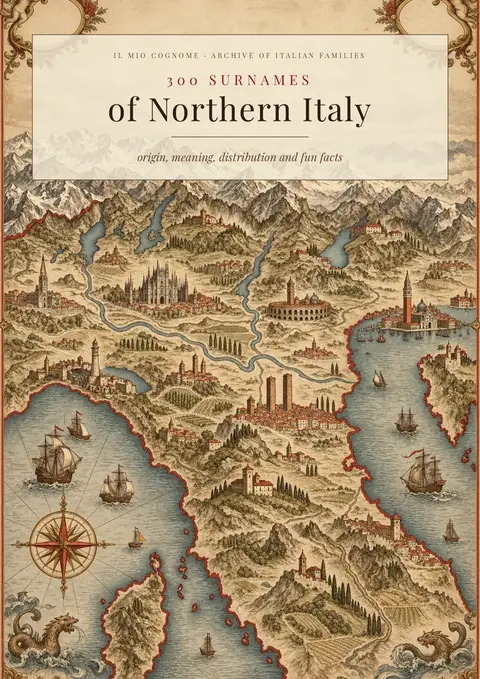
The Northern Italy volume picks 300 surnames from eight regions. This one is devoted to Emilia-Romagna alone: eight chapters on the region’s peoples and stories and, when there is one, the place where each surname ranks highest in the region. 35 surnames are in both: the other 265 you’ll find only here.
Will I find the surnames of my province?
At the back of the volume an index gathers, province by province, the surnames most common there: 274 surnames from the book, spread across the nine provinces from Bologna to Rimini. There’s also the list of the 51 towns in Emilia-Romagna where a surname from the book is the most common.
What’s the difference between the volume and a surname booklet?
In the volume each surname has a half-page entry: origin, map, variants and a fun fact. The booklet is devoted to a single surname and tells its story, its towns and its distribution in 12-19 pages, with a family tree and a surname scroll personalized with that surname.
Does the volume tell me who my ancestors were?
No. A surname tells you where a word comes from, and two families with the same surname can have completely different stories. At the back of the volume there’s a guide to start searching for your ancestors in the archives, free and from home, with tips for Emilia-Romagna, where Italian civil registration begins in 1866, after the Napoleonic one, and in the Duchy of Parma and Piacenza civil registers went on even after the Restoration.
Does the volume include my surname’s coat of arms?
No, because a surname has no coat of arms: a coat of arms belonged to one specific branch of a family, not to everyone who carries the surname. When a fun fact mentions one, the entry says which family it belonged to.
What if scholars disagree about the origin?
We tell you. When an origin is certain, it’s written as certain; when it isn’t, the entry carries the gray “disputed origin” badge and gives you the theories.
Can I print it?
Yes, for personal and family use: you can print it for yourself and your relatives.
More volumes from the area
 Surnames of Bologna
100 surnames
 Surnames of Parma
100 surnames
 Surnames of Northern Italy
300 surnames
From the blog: The Most Common Surnames in Italy, Area by Area
Surnames of Emilia-Romagna
Instant PDF · 176 pages
What people say about us
A few of the more than 20,000 comments and messages you’ve left us.
Read all the reviews