
Surnames of Molise
origin, meaning, distribution and fun facts


€19.90 Instant PDF · 179 pages
Buy the volumeOne-time payment, no renewals · Secured by Stripe
- Instant PDF, and the link also arrives by email
- In Italian and English: you get both versions
- A4 format: read it on your phone or print it
Molise was the land of the Samnites, then of the Romans, the Lombards of the Duchy of Benevento and the Normans, and its name comes from the Norman counts de Molisio. In the 15th century families from across the Adriatic, Croats and Albanians, settled here, and in some towns their language is still spoken. Every people left something in the surnames: Colavita and Di Pardo come from the names of fathers, Mastropaolo from the master craftsman, Mirco and Manes from those who crossed the Adriatic.
300surnames
179pages
11history chapters
What’s inside
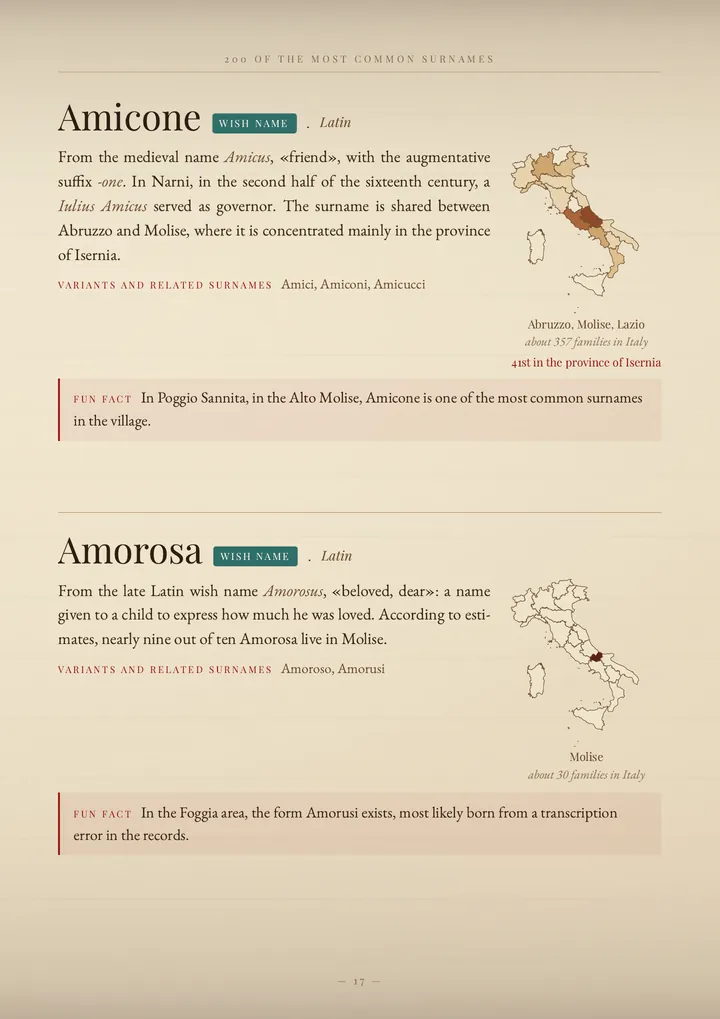
- For each surname, its origin, its meaning and the language it comes from, from Latin to the Germanic of the Lombards, from the Old French of the Normans to Albanian and Croatian
- The map of the Italian regions where it’s common today and an estimate of how many families carry it
- Where it stands in Molise, when the figure exists, meaning its rank in Molise or in the province, or the town where it ranks first
- The variants and related surnames, meaning the other forms and spellings of the same surname
- One fun fact per surname, from a town to a historical figure

Surnames of Molise
Molise’s surnames, people by people
Before Rome, these mountains belonged to the Samnites, a people of shepherds and warriors who spoke Oscan. Molise was the heart of the territory of the Pentri, the strongest tribe, with its capital at Bovianum, today’s Bojano. The Samnites fought three long… continues in the volume
How to recognize a Molisan surname
Some signs are easy to spot. The Di and De before the father’s name: Di Pardo, Di Lena, Di Iorio, De Lena. Double names joined into a single word: Colavita, Gianfelice, Iantomasi. The mastro, the master craftsman: Mastropaolo, Mastroiacovo, Mastromonaco. And… continues in the volume
Province by province
At the back of the volume an index gathers the surnames most common in each province. There are 150 surnames from the book, spread across the two provinces, Campobasso and Isernia. Then comes the list of the 30 Molisan towns where a surname from the book is… continues in the volume
Is your surname in the volume?
Type it below: we'll tell you right away if it's there, and in which volume.
- Amicone
- Amorosa
- Angiolilli
- Antenucci
- Antonecchia
- Antonilli
- Armanetti
- Armenti
- Baranello
- Barrea
- Berardis
- Biello
- Caccavelli
- Cambio
- Capaldi
- Capretta
- Caranci
- Carano
- Chiacchiari
- Chiarizia
- Ciamarra
- Ciarallo
- Ciccaglione
- Ciccarella
- Cicchino
- Ciccotelli
- Cicerone
- Coia
- Colabella
- Colacci
- Coladangelo
- Colagiovanni
- Colalillo
- Colaneri
- Colasurdo
- Colavecchia
- Colavita
- Cordisco
- Cornacchione
- Cristinzio
- Cristofano
- Crivellone
- Cuculo
- Cutone
- D’Abramo
- D’Amicantonio
- D’Ascenzo
- D’Aversa
- De Camillis
- Del Busso
- De Lena
- Del Torto
- Del Zingaro
- De Notariis
- D’Ermes
- Di Cienzo
- Di Ciocco
- Di Cristinzi
- Di Florio
- Di Geronimo
- Di Giammartino
- Di Giglio
- Di Ielsi
- Di Iorio
- Di Iuorio
- Di Lalla
- Di Lallo
- Di Lena
- Di Lisa
- Di Lonardo
- Di Niro
- Di Nucci
- Di Pardo
- Di Pilla
- Di Re
- Di Sandro
- Di Sisto
- Di Tata
- Doganieri
- Donatone
- D’Uva
- Falcione
- Fantetti
- Farinaccio
- Fascia
- Fatica
- Fiorilli
- Forcione
- Formichelli
- Fratamico
- Fratangelo
- Giacomodonato
- Giancola
- Gianfelice
- Gianfrancesco
- Giannantonio
- Giorgetta
- Griguoli
- Iammarino
- Iannacci
- Iannacone
- Iannantuono
- Iannetta
- Ianniruberto
- Iantomasi
- Iavasile
- Ioffredi
- Ionata
- Iuliani
- Iurescia
- Izzi
- Lafratta
- Lancellotta
- Libertucci
- Licursi
- Litterio
- Lupacchino
- Macchiagodena
- Macchiarolo
- Maddonni
- Mainella
- Mancinella
- Manes
- Marcovecchio
- Marraffino
- Mastragostino
- Mastrogiorgio
- Mastrogiuseppe
- Mastroiacovo
- Mastromonaco
- Mastropaolo
- Matteo
- Messere
- Mezzacappa
- Micone
- Mignogna
- Minicucci
- Miniello
- Miniscalco
- Mirco
- Moffa
- Montazzoli
- Morcone
- Moscufo
- Mucciaccio
- Muccilli
- Muccillo
- Musacchio
- Nardolillo
- Nasillo
- Niro
- Occhionero
- Padulo
- Paglione
- Panichella
- Pannunzio
- Papiccio
- Patete
- Perazzelli
- Perrella
- Petrarca
- Petraroia
- Picciano
- Pietrangelo
- Pietrunti
- Pilla
- Plescia
- Porfirio
- Primiani
- Primiano
- Ranallo
- Ricciuto
- Salome
- Santella
- Santoianni
- Santone
- Scarabeo
- Sebastiano
- Sivilla
- Spallone
- Spensieri
- Spidalieri
- Staffieri
- Storto
- Tamasi
- Tamburri
- Terzano
- Tirabasso
- Tullo
- Valiante
- Vassalotti
- Veneziale
- Vignone
- Vincelli
- Vitantonio
- Vitone
- Vitulli
- Zappitelli
- Zappone
- Zeffiro
- Abiuso
- Berchicci
- Bracone
- Cacchione
- Calleo
- Campellone
- Campofredano
- Cannarsa
- Carmosino
- Casolino
- Castrataro
- Cefaratti
- Centracchio
- Cerimele
- Cerio
- Chimisso
- Chiovitti
- Ciafardini
- Cianfrani
- Ciarlariello
- Cifelli
- Cimorelli
- Ciummo
- Civico
- Colamaio
- Colitti
- D’Adderio
- D’Agnillo
- D’Aulerio
- Del Riccio
- De Socio
- Di Corpo
- Di Criscio
- Di Lisio
- Di Nezza
- Di Ninno
- Discenza
- Fraraccio
- Fuschino
- Gianfagna
- Gianserra
- Giovannitti
- Glave
- Iacampo
- Iacurto
- Iademarco
- Ialenti
- Iallonardi
- Iamartino
- Iammatteo
- Ianiro
- Iapalucci
- Iapaolo
- Iarocci
- Incollingo
- Intrevado
- Iocca
- Lamelza
- Lanese
- Larivera
- Latessa
- Laurelli
- Listorti
- Lomma
- Maglieri
- Mascilongo
- Masciotra
- Matticoli
- Meffe
- Melaragno
- Menanno
- Minadeo
- Muccino
- Mustillo
- Petrecca
- Pietraroia
- Potena
- Prioriello
- Rateni
- Ruccolo
- Ruscitto
- Santopolo
- Sappracone
- Scasserra
- Sepede
- Serpone
- Sferra
- Silvaroli
- Simiele
- Siravo
- Sorella
- Stinziani
- Tavone
- Tomaro
- Trivisonno
- Varanese
- Varriano
- Vergalito
- Vizzarri
- Zarlenga
The 10 most common surnames, in short
What they mean, in one sentence. The rest of the story is in the volume, and every surname has its own booklet.
- Pilla
Perhaps from the medieval name Pilla, used in the area between Benevento and Foggia.
The full story of the Pilla surname →- Izzi
There are three theories. From the name Albizzo, or from Izzo, the Italian form of the Germanic Hitz, linked to hild, “battle”. Or from the old word izzo, which referred to a Saracen or a dark-skinned person. Izzi is a surname of Lazio and Molise, strong in the province of Isernia.
The full story of the Izzi surname →- Niro
From the Latin niger, “black”: a nickname for someone with dark hair or a dark complexion.
The full story of the Niro surname →- Mignogna
From a nickname linked to the word mignone, “small, cute, charming”, but also “favorite”, in either an affectionate or a mischievous sense.
The full story of the Mignogna surname →- D’Aversa
From the city of Aversa, in the province of Caserta: it indicated the place the family came from.
The full story of the D’Aversa surname →- Manes
According to the tradition gathered by surname scholars, the Manes came from Albania in the second half of the fifteenth century, at the time of Giorgio Castriota Scanderbeg.
The full story of the Manes surname →- Matteo
From the Latin name Mattheus, which comes from Hebrew and means “gift of God”.
The full story of the Matteo surname →- Musacchio
From the Albanian surname Muzaka, belonging to a great noble family of medieval Albania.
The full story of the Musacchio surname →- Petrarca
From Petro, a dialect form of Pietro, itself from the Latin petra, “stone.”
The full story of the Petrarca surname →- Cordisco
Probably from Cordesco, a locality in the Teramo area, the family’s place of origin.
The full story of the Cordisco surname →
Frequently asked questions
Is my surname in the volume?
The full list of the 300 surnames is on this page. The full story of your surname, written for you, is in the €9.50 booklet on the “Your surname story” page.
How is it different from the volume on the South and the Islands?
The South volume picks 300 surnames from eight regions. This one is devoted to Molise alone: eleven chapters on the region’s peoples and stories and, when there is one, the place in Molise where each surname ranks highest. 2 surnames are in both: the other 298 you’ll find only here.
Will I find the surnames of my province?
At the back of the volume an index gathers the surnames most common in each province. There are 150 surnames from the book, spread across Campobasso and Isernia. There’s also the list of the 30 Molisan towns where a surname from the book is the most common.
What’s the difference between the volume and a surname booklet?
In the volume each surname has a half-page entry: origin, map, variants and a fun fact. The booklet is devoted to a single surname and tells its story, its towns and its distribution in 12-19 pages. It also has a family tree and a surname scroll personalized with that surname.
Does the volume tell me who my ancestors were?
No. A surname tells you where a word comes from, and two families with the same surname can have completely different stories. At the back of the volume there’s a guide to searching for your ancestors in the archives, free and from home. It includes tips for Molise, where, as in the whole Kingdom of Naples, the municipalities have kept civil registration records since 1809.
Does the volume include my surname’s coat of arms?
No, because a surname has no coat of arms. A coat of arms belonged to one specific branch of a family, not to everyone who carries the surname. When a fun fact mentions one, the entry says which family it belonged to.
What if scholars disagree about the origin?
We tell you. When an origin is certain, it’s written as certain. When it isn’t, the entry carries the gray “disputed origin” badge and gives you the theories. For some extremely rare surnames that, in the sources consulted, nobody has yet explained, the entry says exactly that.
Can I print it?
Yes, for personal and family use: you can print it for yourself and your relatives.
More volumes from the area
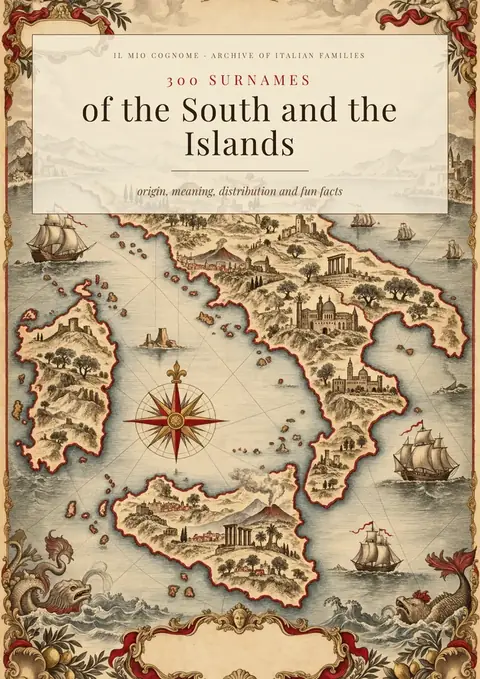 Surnames of the South and the Islands
Surnames of Molise
Instant PDF · 179 pages
What people say about us
A few of the more than 20,000 comments and messages you’ve left us.
Read all the reviews