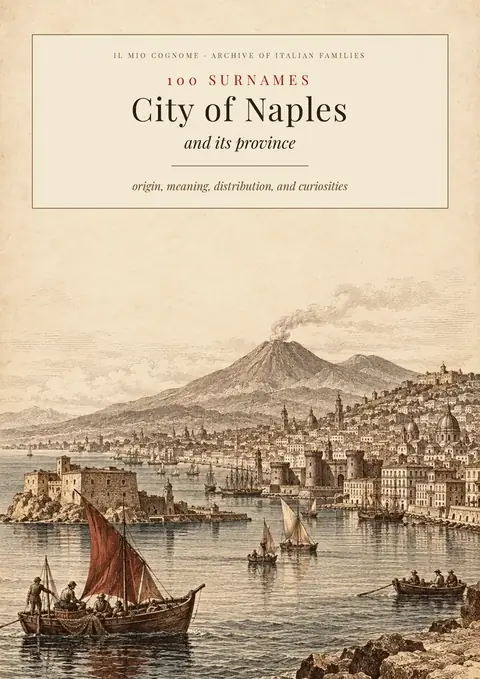
Surnames of Naples
origin, meaning, distribution and fun facts


€14.90 Instant PDF · 74 pages
Buy the volumeOne-time payment, no renewals · Secured by Stripe
- Instant PDF, and the link also arrives by email
- In Italian and English: you get both versions
- A4 format: read it on your phone or print it
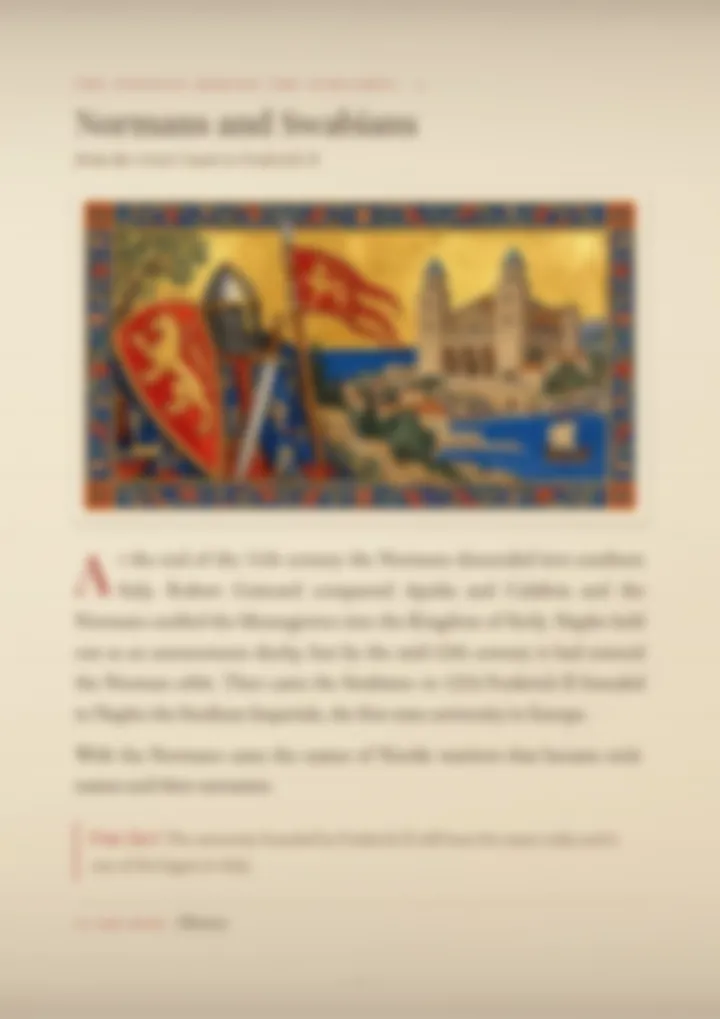
In 1442 Alfonso V of Aragon conquered Naples, and for two and a half centuries the South had Spanish kings and then viceroys. Before that came the Greeks of Cumae, Byzantium, the Normans and Frederick II, who founded the first state university in Europe here in 1224. Each of them left something in today’s surnames: a Greek word or the name of a town in Campania.
100surnames
74pages
7history chapters
What’s inside
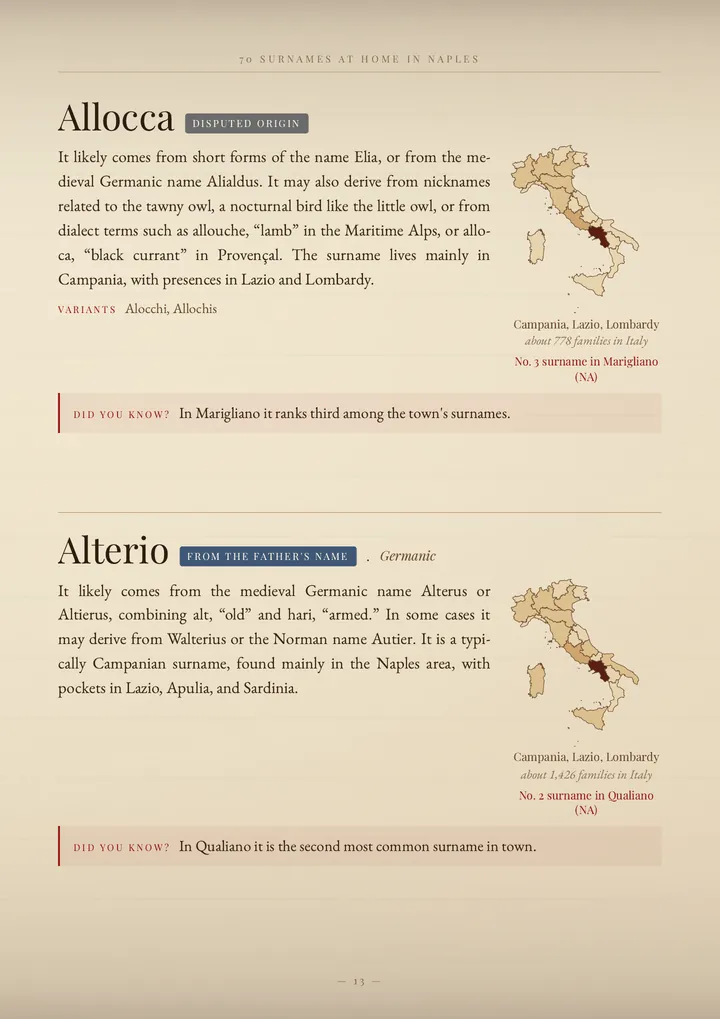
- For each surname, its origin, its meaning and the language it comes from, from Latin to Greek and Germanic
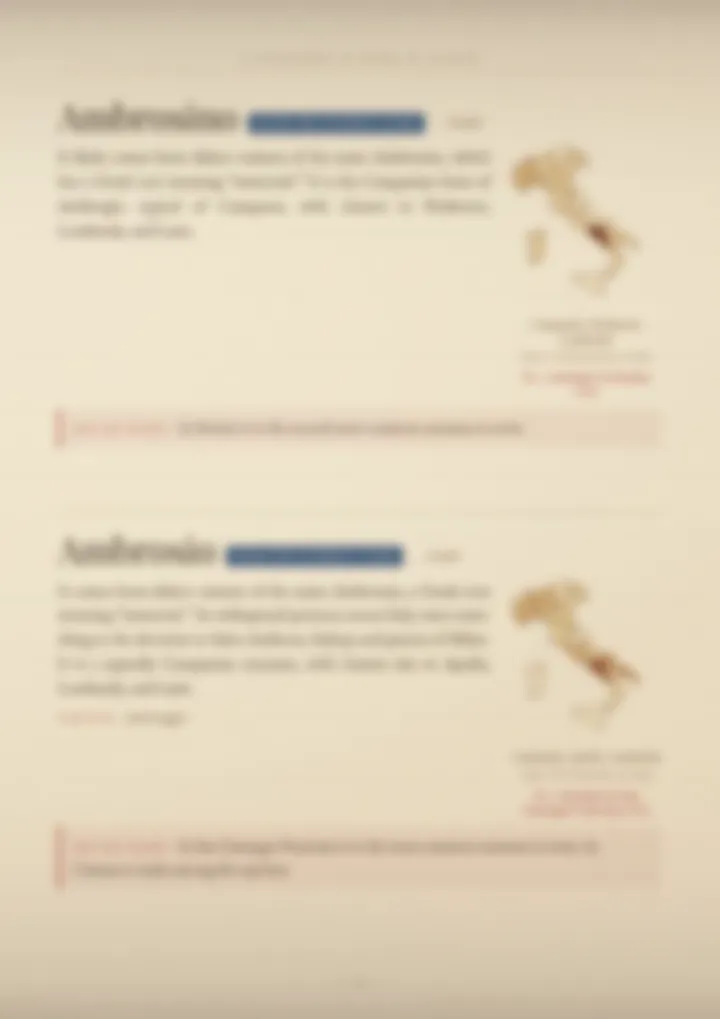
- The map of the Italian regions where it’s common today and an estimate of how many families carry it
- The Neapolitan ranking, when there is one, meaning the town in the province where the surname ranks first or in the top three, or its place in the province’s ranking
- The variants, meaning the other forms and spellings of the same surname
- One fun fact per surname, from a town to a historical figure

Surnames of Naples
The surnames of Naples, people by people
Naples was born Greek: around 470 BC, settlers from Cumae founded Neapolis, “the new city.” Then came Byzantium, the Normans and the Swabians. In 1224 Frederick II founded the Studium Imperiale in Naples, the first state university in Europe. In 1442 Alfonso… continues in the volume
How to recognize a surname from Naples
Some signs are easy to spot. The D’ in front, meaning “son of”: D’Alterio, D’Esposito. Names of faith, like Incarnato or Prete. The matronymic Donnarumma, born from “the lady Domenica.” And many surnames that are place names: Caiazzo, Capuano, Sannino,… continues in the volume
Seventy at home, thirty from the towns
The volume starts with the 70 surnames at home in Naples, the ones that count more families in the province than anywhere else in Italy. Then come 30 surnames from the smaller towns, rare, sometimes very rare, tied to one or two municipalities. Esposito,… continues in the volume
The indexes at the back
At the back, one index lists the nineteen surnames carried by the most families between Naples and its towns. Another gives the No. 1 surname of 92 municipalities in the province, from Acerra to Volla. It marks the ones told in the volume. An index by origin… continues in the volume
Is your surname in the volume?
Type it below: we'll tell you right away if it's there, and in which volume.
- Allocca
- Alterio
- Ambrosino
- Ambrosio
- Ascione
- Auricchio
- Auriemma
- Avino
- Balzano
- Bifulco
- Boccia
- Borriello
- Brancaccio
- Buono
- Caccavale
- Caiazzo
- Caliendo
- Capuano
- Carotenuto
- Casillo
- Castiello
- Cimmino
- D’Alterio
- De Falco
- Donnarumma
- Falanga
- Falco
- Fiorentino
- Formisano
- Franzese
- Giugliano
- Iaccarino
- Iavarone
- Iervolino
- Iovino
- Lauro
- Liccardo
- Longobardi
- Lubrano
- Maiello
- Maione
- Maisto
- Manna
- Mattera
- Mennella
- Migliaccio
- Miranda
- Montella
- Musella
- Nappi
- Nappo
- Nocerino
- Nunziata
- Oliviero
- Orefice
- Pirozzi
- Prete
- Prisco
- Punzo
- Salzano
- Sannino
- Savarese
- Saviano
- Schettino
- Somma
- Staiano
- Tammaro
- Terracciano
- Tufano
- Vanacore
- Abagnale
- Assante
- Capolongo
- Casoria
- Castellone
- Della Ragione
- D’Esposito
- Di Bonito
- Errichiello
- Ilardi
- Imperato
- Incarnato
- Lanzaro
- Liguoro
- Mercogliano
- Minichini
- Monda
- Montanino
- Napolano
- Ottaiano
- Patalano
- Puzone
- Raia
- Soviero
- Terminiello
- Tizzano
- Vacchiano
- Vallefuoco
- Varchetta
- Volpicelli
The 10 most common surnames, in short
What they mean, in one sentence. The rest of the story is in the volume, and every surname has its own booklet.
- Ambrosio
It comes from dialect variants of the name Ambrosius, a Greek root meaning “immortal.”
The full story of the Ambrosio surname →- Falco
The origins are uncertain: it likely derives from the ancient Greek name Phalces or from the late Latin Falco and Falconius, or from place names such as Falconara or Falcone; it may also derive from nicknames related to the work of a falconer, someone who trained falcons for hunting.
The full story of the Falco surname →- Prete
It comes from a nickname tied to the religious rank of priest, both in the Catholic and Orthodox traditions.
The full story of the Prete surname →- Manna
It likely derives from a nickname born from a dialect form of the Latin magna, “the great one”.
The full story of the Manna surname →- Fiorentino
Fiorentino derives mostly from the Byzantine-tradition names Florentinus and Florentius, or from place names such as Florence, Fiorenzuola d’Arda, or Fiorenzuola di Focara.
The full story of the Fiorentino surname →- Capuano
It comes from the demonym capuano, meaning “native of the city of Capua,” one of the most important centers of southern Italy during the Middle Ages.
The full story of the Capuano surname →- Lauro
It likely derives from the Latin name Laurus, “he who bears the laurel”, a plant consecrated to Apollo.
The full story of the Lauro surname →- Miranda
It likely derives from the place name Miranda, a town in the province of Isernia in Molise, or from Miranda di Poggiomarino in the province of Naples.
The full story of the Miranda surname →- Buono
It comes from the medieval given name Buonus, which traces back to the Latin nomen Bonus.
The full story of the Buono surname →- Boccia
It likely derives from the medieval given name Boccio or Boccia, recorded in the fifteenth century in San Giovanni Valdarno with Boccia di Niccolò del Rosso, elected commissioner of the Florentine Republic.
The full story of the Boccia surname →
Frequently asked questions
What are the most common surnames in Naples?
At the back of the volume, one index lists the nineteen surnames carried by the most families in the province, and another gives the No. 1 surname of 92 municipalities. They are common outside the province too, and almost all of them are told in the volume Surnames of Campania. Here you’ll find the surnames born in the province of Naples, which you meet much less often elsewhere.
Is my surname from Naples?
If it’s among the 100 on this page, it’s tied to the province of Naples: 70 are at home in the province and 30 belong to one or two towns. If you don’t find it, it may be a surname found all over Campania: look for it in the volume Surnames of Campania. A surname tells you where a word comes from: to learn who your ancestors were, you need the records.
How is it different from the volume on Campania?
The Campania volume gathers 300 surnames from the whole region, including those found in every province, like Esposito, Russo and Romano. This one is devoted to Naples and its towns, with seven chapters on the peoples and stories behind Neapolitan surnames. More than half of the 100 surnames, 53, also appear in the Campania volume.
Will I find the surname of my town?
One index gives the most common surname in 92 municipalities of the province, from Acerra to Volla. The 30 surnames from the towns are rare or very rare: each is tied to one or two municipalities.
Does the volume tell me who my ancestors were?
No. A surname tells you where a word comes from. Two families with the same surname can have completely different stories. At the back of the volume there’s a guide to start searching for your ancestors, free and from home, with tips for Campania, where civil registration began in 1809.
Does the volume include my surname’s coat of arms?
No, because a surname has no coat of arms: a coat of arms belonged to one specific branch of a family, not to everyone who carries the surname. When a fun fact mentions one, the entry says which family it belonged to.
What if scholars disagree about the origin?
We tell you. When an origin is certain, it’s written as certain; when it isn’t, the entry carries the gray “disputed origin” badge and gives you the theories.
Can I print it?
Yes, for personal and family use: you can print it for yourself and your relatives.
 Surnames of Campania
 Surnames of the South and the Islands
Surnames of Naples
Instant PDF · 74 pages
What people say about us
A few of the more than 20,000 comments and messages you’ve left us.
Read all the reviews