
Surnames of Padua
origin, meaning, distribution and fun facts


€14.90 Instant PDF · 72 pages
Buy the volumeOne-time payment, no renewals · Secured by Stripe
- Instant PDF, and the link also arrives by email
- In Italian and English: you get both versions
- A4 format: read it on your phone or print it
According to an ancient legend, Padua was founded by the Trojan prince Antenor after the Trojan War. In 1176 the city joined the Lombard League that stopped Frederick Barbarossa at Legnano. In 1601 the ghetto was established. Everyone who passed through left something in the surnames: the name of a northern warrior, a Greek word, the name of a town.
100surnames
72pages
5history chapters
What’s inside
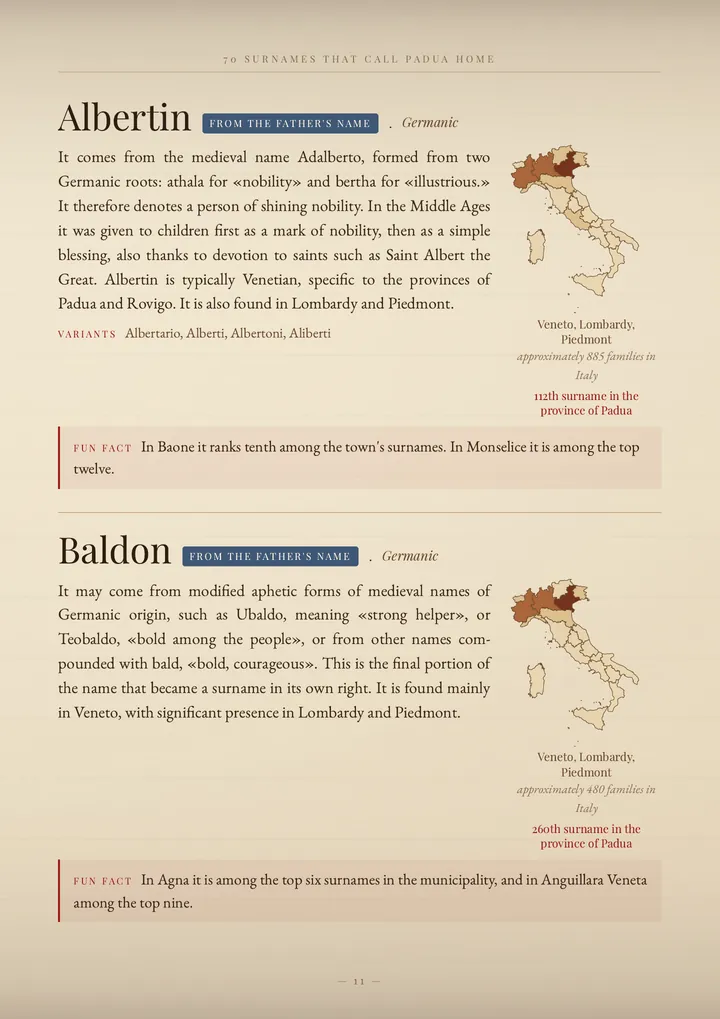
- For each surname, its origin, its meaning and the language it comes from, from Latin to Greek and Germanic
- The map of the Italian regions where it’s common today and an estimate of how many families carry it
- Its standing in the province, when there is one, meaning the town in the province where the surname ranks first or in the top three, or its place in the province’s ranking
- The variants, meaning the other forms and spellings of the same surname
- One fun fact per surname, from a town to a historical figure

Surnames of Padua
The surnames of Padua, one people at a time
Padua was not born a Greek city, but the Greek language arrived all the same: through the Church, Venice’s trade routes and the university. In 568 the Lombards crossed the Alps, and Padua was among the last cities of the Veneto plain to hold out. In 1601 the… continues in the volume
How to recognize a surname from Padua
Some signs are easy to spot. The suffixes -in and -ato, typical of the Veneto dialect: Albertin, Fortin, Masin and Rubin on one side, Ruffato, Toniato, Vigato and Zoccarato on the other. The stress on the final syllable, which records and computers have… continues in the volume
Seventy at home, thirty from the towns
The volume starts with the 70 surnames at home in Padua, the ones that count more families in the province than anywhere else in Italy. Then come 30 surnames from the smaller towns, rare, sometimes very rare, tied to one or two municipalities. They come from… continues in the volume
The indexes at the back
At the back, one index lists the twenty surnames carried by the most families between Padua and its towns. Another gives the No. 1 surname of 100 municipalities in the province, from Abano Terme to Vo’, and marks the ones covered in the volume. An index by… continues in the volume
Is your surname in the volume?
Type it below: we'll tell you right away if it's there, and in which volume.
- Albertin
- Baldon
- Baraldo
- Barison
- Bassan
- Bellotto
- Belluco
- Bertazzo
- Bertocco
- Bettella
- Bisello
- Boaretto
- Brotto
- Buson
- Calore
- Camporese
- Capuzzo
- Cardin
- Carpanese
- Casotto
- Cesaro
- Chinello
- Contin
- Crivellaro
- Dainese
- Facco
- Fasolato
- Fasolo
- Fassina
- Fornasiero
- Fortin
- Franchin
- Friso
- Galiazzo
- Giacometti
- Giacon
- Giraldo
- Gomiero
- Greggio
- Lazzaro
- Luise
- Manfrin
- Maretto
- Maritan
- Masin
- Nicoletto
- Noventa
- Pedron
- Pilotto
- Pinato
- Piovan
- Ranzato
- Rubin
- Ruffato
- Salvato
- Sartore
- Scapin
- Sinigaglia
- Sturaro
- Tasinato
- Toffanin
- Tonello
- Toniato
- Vettorato
- Vettore
- Volpin
- Zaramella
- Zoccarato
- Zorzi
- Zulian
- Arzenton
- Babolin
- Baccarin
- Baesso
- Ballan
- Bano
- Boggian
- Brasola
- Cabrele
- Candeo
- Ceccarello
- Comunian
- Disarò
- Ferraretto
- Gardin
- Meggiorin
- Melato
- Pistore
- Rostellato
- Ruggero
- Salvagnin
- Selmin
- Sguotti
- Squarcina
- Tognin
- Tombolato
- Turlon
- Vigato
- Zanchin
- Zerbetto
The 10 most common surnames, in short
What they mean, in one sentence. The rest of the story is in the volume, and every surname has its own booklet.
- Zorzi
It derives from dialectal modifications of the name Giorgio, which comes from the medieval Greek Gheorghios, from the word gheorgos meaning “farmer”.
The full story of the Zorzi surname →- Lazzaro
Perhaps comes from a place name such as Lazzaro in the province of Reggio Calabria, or from other locations with the same name scattered across Italy.
The full story of the Lazzaro surname →- Giacometti
Probably comes from variations of the name Giacomo, which traces back to the Hebrew Ya’aqov and means follower of God.
The full story of the Giacometti surname →- Tonello
It likely derives from the apheresis and dialectal modifications of the name Antonio.
The full story of the Tonello surname →- Cesaro
It likely derives from the cognomen of the Roman gens Caesar, meaning “great”.
The full story of the Cesaro surname →- Sinigaglia
It probably derives from the place name Senigallia, in the Marche region, in the province of Ancona: whoever first bore it came from that city or recalled its origins.
The full story of the Sinigaglia surname →- Crivellaro
It likely arose from nicknames tied to two related words. The first is the old dialect word crivell, the mold used to shape hats: the person who worked with it was a hatter. The second is crivello, the miller’s sieve. The sources leave the choice between the two trades open. It is a surname of northern Italy with its main home in Veneto.
The full story of the Crivellaro surname →- Scapin
It derives from the late Latin name Scapinus, recorded in 1151 in a medieval document where two young brothers bear the names Brilionus and Scapinus.
The full story of the Scapin surname →- Zulian
In some cases it may derive from the demonym of Venezia Giulia, but far more probably from the medieval name Zulianus, an archaic form of Giuliano.
The full story of the Zulian surname →- Sartore
It likely derives from the Latin cognomen Sartorius, linked to the term sartor, meaning “tailor”.
The full story of the Sartore surname →
Frequently asked questions
What are the most common surnames in Padua?
First place goes to Carraro, with about 1,571 families in the province. At the back of the volume, one index lists the twenty surnames carried by the most families and another gives the No. 1 surname of 100 municipalities. They are common outside the province too, and almost all of them are covered in the volume Surnames of Veneto. Here you’ll find the surnames born in the province of Padua, which you meet much less often elsewhere.
Is my surname from Padua?
If it’s among the 100 on this page, it’s tied to the province of Padua: 70 are at home in the province and 30 belong to one or two towns. If you don’t find it, it may be a surname found all over Veneto: then look for it in the volume Surnames of Veneto. A surname tells you where a word comes from: to learn who your ancestors were, you need the records.
How is it different from the volume on Veneto?
The Veneto volume gathers the surnames of the whole region, including those found in every province, like Carraro, Schiavon and Masiero. This one is devoted to Padua and its towns, with five chapters on the peoples and stories behind Padua’s surnames.
Will I find the surname of my town?
One index gives the most common surname in 100 municipalities of the province, from Abano Terme to Vo’. The 30 surnames from the towns are rare, sometimes very rare, and each is tied to one or two municipalities.
Does the volume tell me who my ancestors were?
No. A surname tells you where a word comes from, and two families with the same surname can have completely different stories. At the back of the volume there’s a guide to start searching for your ancestors, free and from home, with tips for Veneto, where civil registration began in 1871.
Does the volume include my surname’s coat of arms?
No, because a surname has no coat of arms: a coat of arms belonged to one specific branch of a family, not to everyone who carries the surname. When a fun fact mentions one, the entry says which family it belonged to.
What if scholars disagree about the origin?
We tell you. When an origin is certain, it’s written as certain; when it isn’t, the entry carries the gray “disputed origin” badge and gives you the theories.
Can I print it?
Yes, for personal and family use: you can print it for yourself and your relatives.
More volumes from the area
 Surnames of Veneto
300 surnames
 Surnames of Venice
100 surnames
 Surnames of Verona
100 surnames
 Surnames of Northern Italy
300 surnames
From the blog: The Most Common Surnames in Italy, Area by Area
Surnames of Padua
Instant PDF · 72 pages
What people say about us
A few of the more than 20,000 comments and messages you’ve left us.
Read all the reviews