
Surnames of Piedmont
origin, meaning, distribution and fun facts


€19.90 Instant PDF · 179 pages
Buy the volumeOne-time payment, no renewals · Secured by Stripe
- Instant PDF, and the link also arrives by email
- In Italian and English: you get both versions
- A4 format: read it on your phone or print it
In Piedmont many surnames carry the trade written at the end: Ferrero is the blacksmith, Cordero the rope maker, Bottero the cooper. Others have De attached and the notaries’ -is, like Demichelis and Destefanis. Others still are Germanic names brought by the Lombards and the Franks: Arduino, Aimone, Oddone. Then there are the surnames of the Occitan valleys and those born at the court of the House of Savoy.
300surnames
179pages
10history chapters
What’s inside
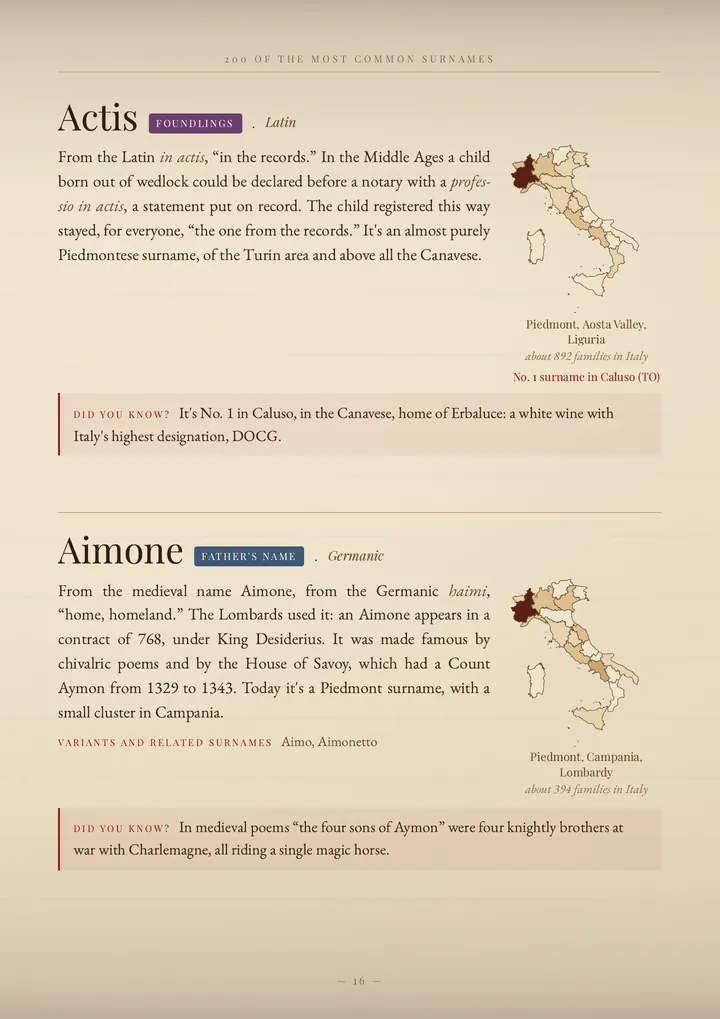
- For each surname, its origin, its meaning and the language it comes from, from Latin to the Germanic of the Lombards and Franks
- The map of the Italian regions where it’s common today and an estimate of how many families carry it
- The Piedmontese record, when there is one, meaning its rank in the region or the province, or the town where it’s near the top
- The variants and related surnames, meaning the other forms and spellings of the same surname
- One fun fact per surname, from a town to a historical figure
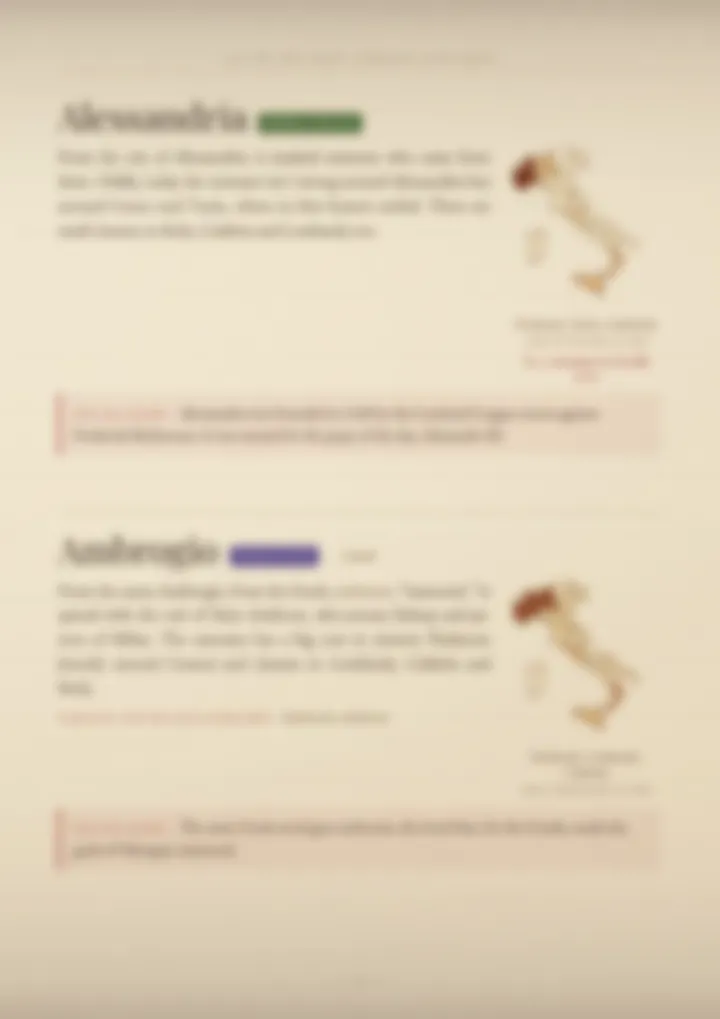

Surnames of Piedmont
Piedmont’s surnames, people by people
Before the Romans, Piedmont was a land of Ligurians and Celts. The Taurini lived in the plain of Turin, the Bagienni around Cuneo. Few of their words remain, like comba, the narrow valley, which gave the surname Comba. The Romans founded grid-plan cities,… continues in the volume
How to recognize a Piedmontese surname
Some signs are easy to spot. The final -ero is the signature of the trades: Ferrero is the blacksmith, Cordero the rope maker, Bottero the cooper. The diminutive in -ino is typical of the region: Bertino, Baudino, Giachino. Then there’s De attached to the… continues in the volume
Province by province
At the back of the volume an index gathers, province by province, the surnames most common there. There are 288 surnames from the book, spread across the eight provinces from Alessandria to Vercelli. Then comes the list of the 146 Piedmontese towns where a… continues in the volume
Is your surname in the volume?
Type it below: we'll tell you right away if it's there, and in which volume.
- Actis
- Aimone
- Alessandria
- Ambrogio
- Amerio
- Anselmo
- Arduino
- Armando
- Audisio
- Bagnasco
- Baima
- Balbo
- Balocco
- Barale
- Barberis
- Barbero
- Barisone
- Baudino
- Beccaria
- Bellino
- Beltramo
- Benedetto
- Bergese
- Bersano
- Berta
- Bertero
- Bertino
- Bertola
- Bertolino
- Bertolotto
- Bertone
- Bessone
- Bianciotto
- Bianco
- Bisio
- Bo
- Bocca
- Boero
- Boffa
- Boggio
- Bolla
- Bona
- Bonetto
- Bongiovanni
- Bonino
- Borello
- Borgna
- Borgogno
- Borio
- Borra
- Bosco
- Bosso
- Botta
- Bottero
- Botto
- Bovio
- Bracco
- Brero
- Bruno
- Brusa
- Busso
- Cane
- Capello
- Cappa
- Carena
- Caretti
- Casetta
- Castagno
- Cavallero
- Cena
- Cerrato
- Cerruti
- Cerutti
- Coda
- Comba
- Coppo
- Cordero
- Corino
- Cortese
- Costamagna
- Cravero
- Dalmasso
- Demaria
- Demichelis
- Destefanis
- Dotta
- Durando
- Dutto
- Enrico
- Fantino
- Fassio
- Fenoglio
- Ferraris
- Ferrero
- Fissore
- Fornara
- Fornero
- Forno
- Franco
- Gai
- Gaido
- Galliano
- Gallo
- Garelli
- Gariglio
- Garino
- Garnero
- Garrone
- Gastaldi
- Gastaldo
- Ghigo
- Ghio
- Ghione
- Giaccone
- Giachino
- Giacosa
- Giai
- Gianotti
- Gili
- Gilli
- Giordana
- Giraudo
- Gonella
- Grosso
- Guglielmetti
- Icardi
- Ivaldi
- Lanfranco
- Lovera
- Macario
- Magliano
- Maina
- Mana
- Mancin
- Marchisio
- Marenco
- Marengo
- Maritano
- Marocco
- Masoero
- Massa
- Merlo
- Miglio
- Milanese
- Milano
- Mina
- Molino
- Mollo
- Mondino
- Monticone
- Morando
- Mosca
- Mosso
- Musso
- Nicola
- Novara
- Oberto
- Panero
- Pavese
- Penna
- Perino
- Perotti
- Piana
- Piovano
- Poggio
- Pons
- Pozzo
- Prato
- Racca
- Ramella
- Rapetti
- Ravera
- Regis
- Repetto
- Revello
- Ricca
- Rinaudo
- Rivoira
- Roggero
- Rolando
- Rolfo
- Rolle
- Ronco
- Rosso
- Rostagno
- Ruffino
- Sacco
- Saracco
- Savio
- Scaglia
- Siviero
- Tuninetti
- Varetto
- Vercelli
- Viale
- Viano
- Vietti
- Vigna
- Vittone
- Zanetta
- Abba
- Aimar
- Aime
- Aimo
- Alberto
- Allione
- Ambroggio
- Antoniotti
- Arnaudo
- Bagnati
- Balla
- Baravalle
- Battaglino
- Bava
- Becchio
- Berardo
- Bertaina
- Bertello
- Bertinetti
- Bertinotti
- Bertolone
- Binello
- Bionda
- Boasso
- Bobba
- Bozzola
- Brignolo
- Brizio
- Bruna
- Cagliero
- Caligaris
- Canavese
- Caprioglio
- Carosso
- Casalegno
- Castellino
- Cauda
- Chiarle
- Clerico
- Cornaglia
- Davico
- Degiovanni
- Dellavalle
- Demarchi
- Depetris
- Dogliani
- Favro
- Ferrua
- Forneris
- Franchino
- Francone
- Frola
- Gallino
- Garella
- Garello
- Gattoni
- Gay
- Genta
- Ghibaudo
- Ghigliano
- Giorgis
- Gioria
- Gotta
- Gramaglia
- Gualco
- Lingua
- Lisa
- Lorenzatto
- Lusso
- Maffeo
- Maggiora
- Mandrile
- Manzone
- Martinengo
- Mazzarello
- Moncalvo
- Morino
- Occelli
- Oddone
- Oggero
- Passaggio
- Peirone
- Perucca
- Piacenza
- Pilone
- Ragazzoni
- Ramello
- Raviola
- Revelli
- Rey
- Semino
- Suppo
- Tarditi
- Usseglio
- Vallero
- Valsesia
- Vercellino
- Viana
- Vignolo
- Vinai
The 10 most common surnames, in short
What they mean, in one sentence. The rest of the story is in the volume, and every surname has its own booklet.
- Bruno
From the name Bruno, “dark”: at first a nickname for someone with dark hair or skin, then a first name, helped along by saints like Saint Bruno of Cologne.
The full story of the Bruno surname →- Franco
Three paths. The Latin name Francus, the Germanic name Frank, or a nickname for someone who belonged to the Franks. Over time “franco” also came to mean “free.” It’s scattered all over Italy, but in Piedmont it’s among the region’s top ten and seventh in the province of Asti.
The full story of the Franco surname →- Gallo
Several possible paths. The medieval name Gallo, also spread by the cult of Saint Gall, an Irish monk; a nickname tied to the rooster; an ethnic origin, “of the Gauls”; or places like Gallo di Grinzane, near Cuneo. It’s one of Italy’s most common surnames: in Piedmont it ranks fourth in the region and third in Turin province.
The full story of the Gallo surname →- Bianco
From the nickname “bianco,” white, for people with very fair hair or skin.
The full story of the Bianco surname →- Rosso
The red one, in the singular: the form of Piedmont, Veneto and Liguria.
The full story of the Rosso surname →- Bosco
A “bosco” is a wood, and that can mean many things: a woodcutter’s trade, a house near the forest, a place called Bosco, even a slightly wild character.
The full story of the Bosco surname →- Sacco
Two theories. A trade nickname, for someone who made, sold or carried sacks, or a short form of the biblical name Isacco (Isaac), “God smiles.” It’s a surname found all over Italy, but in Piedmont it is among the region’s top fifty and ninth in the province of Novara.
The full story of the Sacco surname →- Ferrero
The blacksmith, in Piedmontese. The final -ero is the Piedmontese form of the Latin trade ending -arius, as in Barbero and Cravero.
The full story of the Ferrero surname →- Massa
From one of the many places called Massa: Massa in Tuscany, Massa di Somma near Naples, Massa Lubrense and others.
The full story of the Massa surname →- Grosso
From the medieval name Grossus, “stout, big-built.”
The full story of the Grosso surname →
Frequently asked questions
Is my surname in the volume?
The full list of the 300 surnames is on this page. The full story of your surname, written for you, is in the €9.50 booklet on the “Your surname story” page.
How is it different from the volume on Northern Italy?
The Northern Italy volume picks 300 surnames from eight regions. This one is devoted to Piedmont alone: ten chapters on the region’s peoples and stories and, when there is one, each surname’s Piedmontese record. 46 surnames are in both: the other 254 you’ll find only here.
Will I find the surnames of my province?
At the back of the volume an index gathers, province by province, the surnames most common there. There are 288 surnames from the book, spread across the eight provinces from Alessandria to Vercelli, not just Turin. There’s also the list of the 146 Piedmontese towns where a surname from the book is the most common.
What’s the difference between the volume and a surname booklet?
In the volume each surname has a half-page entry: origin, map, variants and a fun fact. The booklet is devoted to a single surname and tells its story, its towns and its distribution in 12-19 pages. It also has a family tree and a surname scroll personalized with that surname.
Does the volume tell me who my ancestors were?
No. A surname tells you where a word comes from, and two families with the same surname can have completely different stories. At the back of the volume there’s a guide to searching for your ancestors in the archives, free and from home. The tips are for Piedmont, where civil registration already existed under Napoleon, from 1804 to 1814, and became permanent in 1866.
Does the volume include my surname’s coat of arms?
No, because a surname has no coat of arms. A coat of arms belonged to one specific branch of a family, not to everyone who carries the surname. When a fun fact mentions one, the entry says which family it belonged to.
What if scholars disagree about the origin?
We tell you. When an origin is certain, it’s written as certain. When it isn’t, the entry carries the gray “disputed origin” badge and gives you the theories.
Can I print it?
Yes, for personal and family use: you can print it for yourself and your relatives.
More volumes from the area
 Surnames of Turin
 Surnames of Northern Italy
From the blog: Is Everyone with My Surname Related to Me?
Surnames of Piedmont
Instant PDF · 179 pages
What people say about us
A few of the more than 20,000 comments and messages you’ve left us.
Read all the reviews