
Surnames of Sardinia
origin, meaning, distribution and fun facts


€19.90 Instant PDF · 179 pages
Buy the volumeOne-time payment, no renewals · Secured by Stripe
- Instant PDF, and the link also arrives by email
- In Italian and English: you get both versions
- A4 format: read it on your phone or print it
In Sardinia surnames were born earlier than in the rest of Italy: already in 11th- and 12th-century documents people have a first name and a surname, and Sanna appears in records from 1119. The nuraghe builders, Phoenicians, Romans, Byzantines, the four Judicates, Pisans and Genoese, Catalans and Spaniards, Corsicans and Piedmontese: every people that passed through left something in the surnames families still carry today.
300surnames
179pages
10history chapters
What’s inside
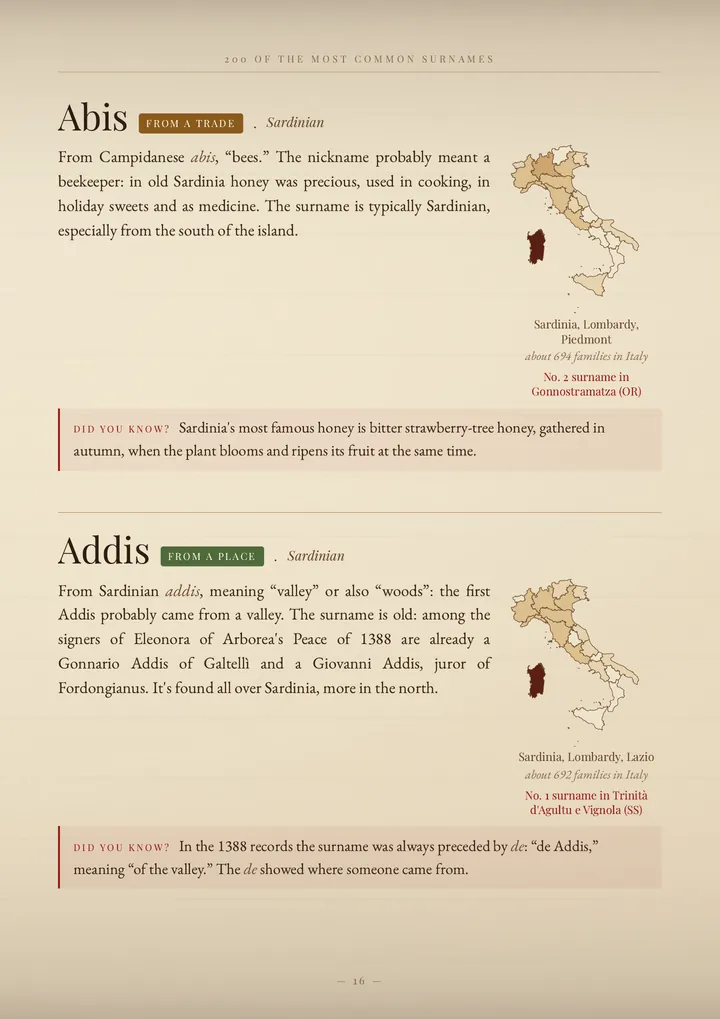
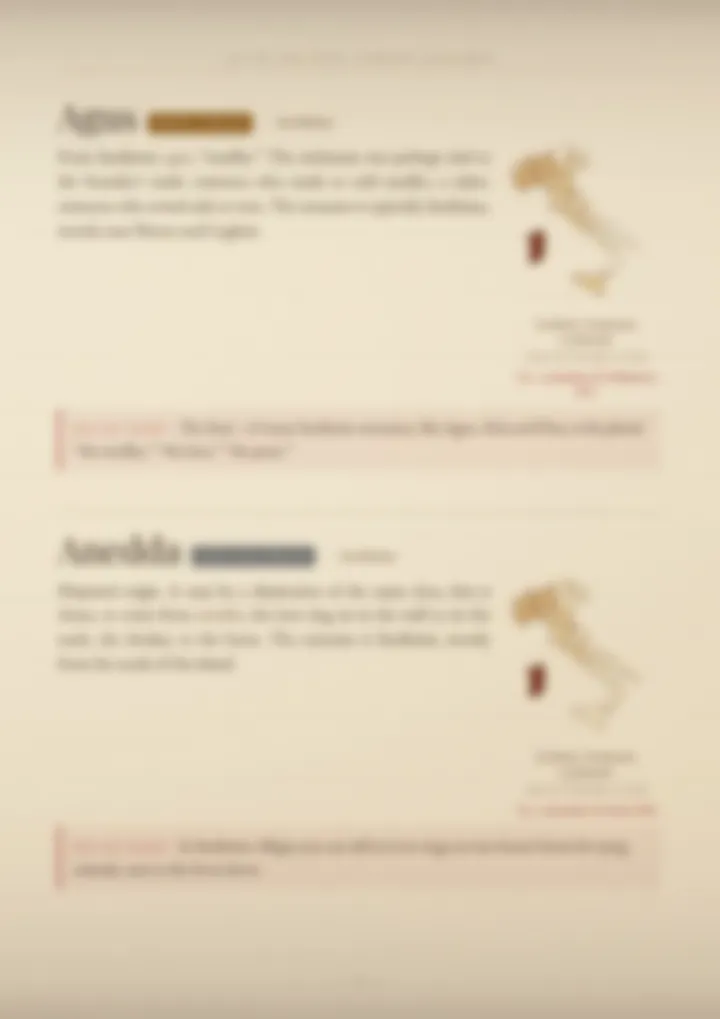
- For each surname, its origin, its meaning and the language it comes from, from Sardinian to Latin, from the Greek of the Byzantines to Catalan and Spanish
- The map of the Italian regions where it’s common today and an estimate of how many families carry it
- The Sardinian record, when there is one, meaning the surname’s rank in Sardinia or the town on the island where it’s No. 1 or near the top
- The variants, meaning the other forms and spellings of the same surname
- One fun fact per surname, from a town to an old document, from a historical figure to a Sardinian word

Surnames of Sardinia
Sardinia’s surnames, people by people
More than three thousand years ago Sardinia was the land of the nuraghi, the dry-stone towers that still number in the thousands. Then came the Phoenicians, who founded Nora, Tharros and Karalis, today’s Cagliari, and for seven hundred years the Romans, who… continues in the volume
How to recognize a Sardinian surname
Many Sardinian surnames are Sardinian words unchanged for almost a thousand years: Sanna is the tusk, Pinna the quill, Piras the pears, Casu the cheese, Frau the blacksmith. And some signs are easy to spot. The final -s of the Sardinian plural: Piras, Agus,… continues in the volume
Province by province
At the back of the volume an index gathers, province by province, the surnames most common there: 295 surnames from the book, spread across the five provinces from Cagliari to South Sardinia. Then comes the list of the 122 Sardinian towns where a surname… continues in the volume
Is your surname in the volume?
Type it below: we'll tell you right away if it's there, and in which volume.
- Abis
- Addis
- Agus
- Anedda
- Angius
- Arca
- Aresu
- Argiolas
- Atzeni
- Atzori
- Azara
- Boi
- Brundu
- Caboni
- Cabras
- Caddeo
- Cadeddu
- Cadoni
- Camboni
- Campus
- Cannas
- Canu
- Cappai
- Cara
- Carboni
- Cardia
- Caredda
- Careddu
- Caria
- Carta
- Casti
- Casu
- Casula
- Cau
- Cherchi
- Chessa
- Cocco
- Cogoni
- Collu
- Concas
- Congiu
- Contini
- Contu
- Corda
- Corona
- Corrias
- Cossu
- Cuccu
- Curreli
- Deiana
- Deidda
- Delogu
- Demontis
- Demuro
- Demurtas
- Deriu
- Desogus
- Dessì
- Dettori
- Diana
- Fadda
- Faedda
- Fais
- Falchi
- Fancello
- Fara
- Farci
- Farris
- Fenu
- Figus
- Fiori
- Flore
- Floris
- Fois
- Frau
- Fresi
- Frongia
- Garau
- Ghiani
- Ibba
- Ladu
- Lai
- Lampis
- Lecca
- Ledda
- Ligas
- Lilliu
- Locci
- Loddo
- Loi
- Maccioni
- Madeddu
- Manca
- Manconi
- Mannu
- Marongiu
- Marras
- Masala
- Mascia
- Masia
- Massa
- Matta
- Mattana
- Medda
- Mei
- Mele
- Melis
- Meloni
- Mereu
- Milia
- Mocci
- Moi
- Montis
- Mulas
- Muntoni
- Mura
- Mureddu
- Murgia
- Murru
- Murtas
- Muscas
- Oggiano
- Olla
- Orrù
- Pala
- Palmas
- Pani
- Pau
- Perra
- Piga
- Pilia
- Pilloni
- Pinna
- Pintus
- Piras
- Piredda
- Pireddu
- Piroddi
- Pisano
- Pisanu
- Pischedda
- Pistis
- Pisu
- Pittalis
- Pittau
- Pitzalis
- Piu
- Podda
- Porceddu
- Porcu
- Porru
- Puddu
- Puggioni
- Pusceddu
- Putzolu
- Putzu
- Ruggiu
- Ruiu
- Saba
- Salaris
- Salis
- Sanna
- Sassu
- Satta
- Scalas
- Scano
- Schirru
- Secchi
- Secci
- Sechi
- Sedda
- Serra
- Simula
- Sini
- Sirigu
- Soddu
- Solinas
- Soro
- Sotgiu
- Spada
- Spano
- Spanu
- Spiga
- Steri
- Sulis
- Tedde
- Tocco
- Tola
- Tolu
- Tronci
- Uras
- Urru
- Usai
- Vacca
- Vargiu
- Virdis
- Zara
- Zedda
- Zucca
- Zuddas
- Abeltino
- Achenza
- Ambu
- Arba
- Ardau
- Asara
- Asuni
- Atzei
- Atzeri
- Bacciu
- Balloi
- Basciu
- Bassu
- Biancu
- Boeddu
- Borrielli
- Brandano
- Brau
- Cabboi
- Cabitza
- Calledda
- Cambarau
- Cambedda
- Canopoli
- Casiddu
- Cinus
- Cirronis
- Coinu
- Cordeddu
- Craba
- Deiosso
- Demelas
- Denotti
- Depalmas
- Desini
- Doneddu
- Espis
- Ferru
- Fideli
- Filigheddu
- Foddi
- Frigau
- Fronteddu
- Fulgheri
- Ganadu
- Gioi
- Gusai
- Lasiu
- Linaldeddu
- Lixi
- Lorrai
- Lussu
- Maciocco
- Macis
- Mainas
- Mandis
- Mannai
- Marcis
- Mastio
- Maxia
- Morittu
- Motzo
- Mulargia
- Mundula
- Muresu
- Muru
- Musiu
- Nateri
- Nioi
- Peru
- Piccinnu
- Pilleri
- Pirastu
- Pirodda
- Pirosu
- Piscedda
- Pittorru
- Porcheddu
- Prinzis
- Puligheddu
- Russu
- Sabiu
- Sanneris
- Sarritzu
- Scintu
- Serreli
- Sibiriu
- Sogus
- Sollai
- Suergiu
- Tilloca
- Truddaiu
- Trullu
- Urgeghe
- Urgu
- Useli
- Vaccargiu
- Vardeu
- Zuncheddu
- Zurru
The 10 most common surnames, in short
What they mean, in one sentence. The rest of the story is in the volume, and every surname has its own booklet.
- Serra
Two paths. The serra is the toothed saw: so the trade of the sawyer or carpenter. But in Sardinian and in many parts of the South the serra is also the mountain crest, the ridge: the first Serra lived up there. In Eleonora’s Peace of 1388 a full 144 Serras sign.
The full story of the Serra surname →- Sanna
In Sardinian sanna is the fang, the protruding tooth: maybe the nickname of a man with prominent teeth, or of someone who lived below a rocky spur.
The full story of the Sanna surname →- Piras
In Sardinian, piras means “pears”: the first Piras perhaps grew pear trees or lived near a pear orchard.
The full story of the Piras surname →- Carta
Tied to paper: the paper of documents, for someone who wrote deeds and contracts, or paper to make and sell.
The full story of the Carta surname →- Pinna
From the Latin pinna, “feather,” which could mean a plume, a quill pen, a fish’s fin or a ridge of rock.
The full story of the Pinna surname →- Meloni
Linked to the apple, the apple tree or the melon, all words that come from the Greek mélon, “fruit.”
The full story of the Meloni surname →- Fiori
From the Latin name Florens or the hopeful name Fiore, “lovely as a flower.”
The full story of the Fiori surname →- Mura
In Sardinian mura is the blackberry or mulberry: perhaps a nickname for someone living near a mulberry tree.
The full story of the Mura surname →- Melis
In Sardinian, mele and meli mean honey: the first Melis may have been a beekeeper, or a person with a sweet nature.
The full story of the Melis surname →- Pisano
“The one from Pisa.” In the Middle Ages the Republic of Pisa ruled the Mediterranean with its merchants and ships, and for a long time governed part of Sardinia.
The full story of the Pisano surname →
Frequently asked questions
Is my surname in the volume?
The full list of the 300 surnames is on this page. The full story of your surname, written for you, is in the €9.50 booklet on the “Your surname story” page.
How is it different from the volume on the South and the Islands?
The South volume picks 300 surnames from eight regions. This one is devoted to Sardinia alone: ten chapters on the island’s peoples and stories and, when there is one, each surname’s Sardinian record. 23 surnames are in both: the other 277 you’ll find only here.
Will I find the surnames of my province?
At the back of the volume an index gathers, province by province, the surnames most common there: 295 surnames from the book, spread across the five provinces from Cagliari to South Sardinia. The other five are common all over Italy. There’s also the list of the 122 Sardinian towns where a surname from the book is the most common.
What’s the difference between the volume and a surname booklet?
In the volume each surname has a half-page entry: origin, map, variants and a fun fact. The booklet is devoted to a single surname and tells its story, its towns and its distribution in 12-19 pages, with a family tree and a surname scroll personalized with that surname.
Does the volume tell me who my ancestors were?
No. A surname tells you where a word comes from, and two families with the same surname can have completely different stories. At the back of the volume there’s a guide to start searching for your ancestors in the archives, free and from home, with tips for Sardinia, where civil registration began in 1866.
Does the volume include my surname’s coat of arms?
No, because a surname has no coat of arms: a coat of arms belonged to one specific branch of a family, not to everyone who carries the surname. When a fun fact mentions one, the entry says which family it belonged to.
What if scholars disagree about the origin?
We tell you. When an origin is certain, it’s written as certain; when it isn’t, the entry carries the gray “disputed origin” badge and gives you the theories.
Can I print it?
Yes, for personal and family use: you can print it for yourself and your relatives.
More volumes from the area
 Surnames of Sardinia · Volume 2
 Surnames of the South and the Islands
Surnames of Sardinia
Instant PDF · 179 pages
What people say about us
A few of the more than 20,000 comments and messages you’ve left us.
Read all the reviews