
Surnames of Florence
origin, meaning, distribution and fun facts


€14.90 Instant PDF · 69 pages
Buy the volumeOne-time payment, no renewals · Secured by Stripe
- Instant PDF, and the link also arrives by email
- In Italian and English: you get both versions
- A4 format: read it on your phone or print it
Florence began as a Roman city. In 1439 the Council brought the Byzantine emperor John VIII Palaeologus to the city with hundreds of Greek scholars. In 1571 Cosimo I de’ Medici confined the Jewish community to the Ghetto. Everyone who passed through left something in the surnames: a Greek name, the name of a warrior from the North or the name of a village in the Mugello.
100surnames
69pages
4history chapters
What’s inside
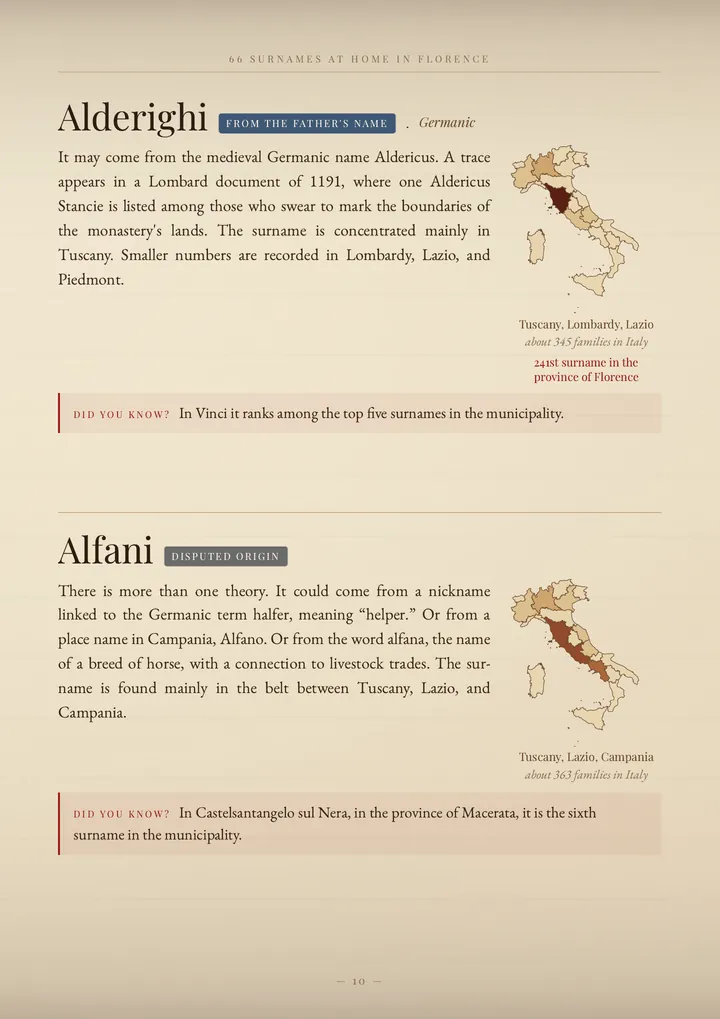
- For each surname, its origin, its meaning and the language it comes from, from Latin to Greek and Germanic
- The map of the Italian regions where it’s common today and an estimate of how many families carry it
- Its standing in the province, when there is one, meaning the town in the province where the surname ranks first or in the top three, or its place in the province’s ranking
- The variants, meaning the other forms and spellings of the same surname
- One fun fact per surname, from a town to a historical figure
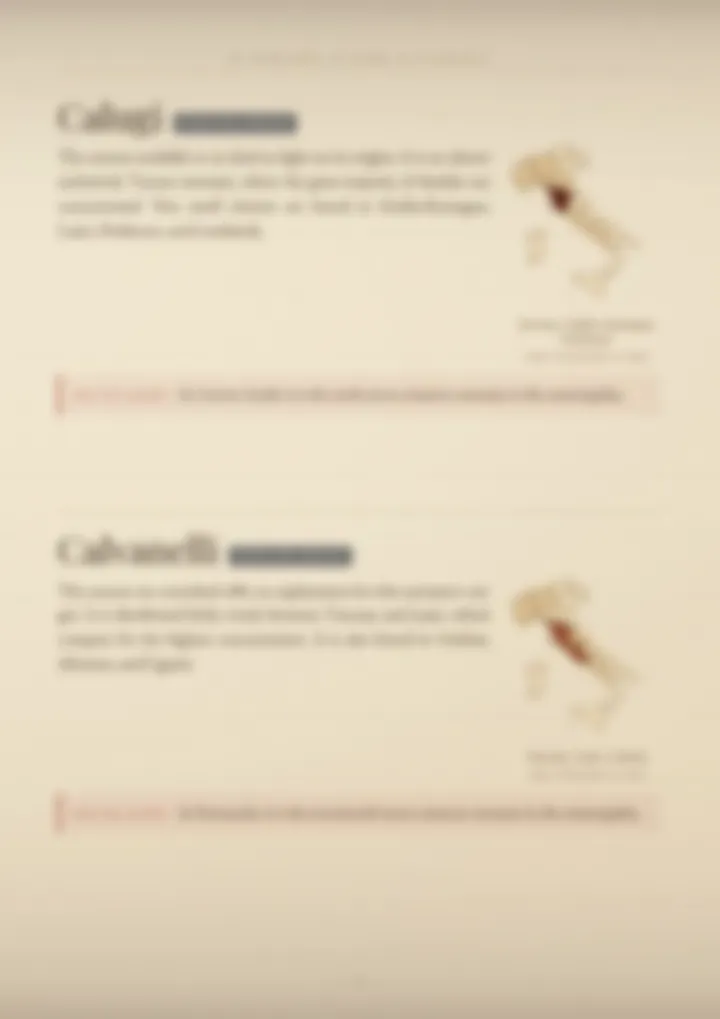

Surnames of Florence
The surnames of Florence, one people at a time
Florence began as a Roman city, but Greek influence arrived early: through the names of saints and through Byzantium’s brief rule over Tuscany. In 1439 the Council of Florence brought the Byzantine emperor John VIII Palaeologus to the city with hundreds of… continues in the volume
How to recognize a surname from Florence
Some signs are easy to spot. The diminutive endings -etti and -ini, which Florentines have always loved: Taccetti, Bongini, Nencetti, Nencioni. Nicknames born in the town square, like Ciucchi, which in old Tuscan meant “fool,” or Tirinnanzi, which recalls… continues in the volume
Sixty-six at home, thirty-four from the towns
The volume starts with the 66 surnames at home in Florence, the ones that count more families in the province than anywhere else in Italy. Then come 34 surnames from the smaller towns, lesser-known, sometimes very rare, tied to one or two municipalities.… continues in the volume
The indexes at the back
At the back, one index lists the twenty surnames carried by the most families between Florence and its towns. Another gives the No. 1 surname of 41 municipalities in the province, from Bagno a Ripoli to Vinci, and marks the ones told in the volume. An index… continues in the volume
Is your surname in the volume?
Type it below: we'll tell you right away if it's there, and in which volume.
- Alderighi
- Alfani
- Bagni
- Bambi
- Barberino
- Barducci
- Barletti
- Bitossi
- Bonechi
- Bongini
- Boretti
- Borselli
- Brotini
- Calamini
- Calugi
- Calvanelli
- Calvelli
- Cammilli
- Campatelli
- Casprini
- Cavini
- Cencetti
- Checcucci
- Ciampolini
- Ciolli
- Ciucchi
- Colzi
- Crescioli
- Danti
- Fallani
- Fibbi
- Firenzuoli
- Forasassi
- Fossi
- Giachetti
- Giunti
- Lapi
- Maestrelli
- Margheri
- Miniati
- Mocali
- Mordini
- Morozzi
- Nencetti
- Nenci
- Nencioni
- Ottanelli
- Pampaloni
- Piazzini
- Pieraccioni
- Pinzani
- Poggiali
- Polverosi
- Puliti
- Quercioli
- Rocchini
- Sani
- Sarri
- Scardigli
- Sottili
- Taccetti
- Tanini
- Tilli
- Torrini
- Zagli
- Zolfanelli
- Affortunati
- Andrei
- Aspettati
- Baracani
- Barchielli
- Caldini
- Calosi
- Casamonti
- Cianti
- Costoli
- Donatini
- Fabbiani
- Falciani
- Frilli
- Frosali
- Giachi
- Gonnelli
- Ignesti
- Magherini
- Malquori
- Manzani
- Marroncini
- Michelagnoli
- Monnetti
- Pancani
- Parentini
- Parretti
- Poggesi
- Ringressi
- Staderini
- Tirinnanzi
- Tognaccini
- Valdarno
- Vivoli
The 10 most common surnames, in short
What they mean, in one sentence. The rest of the story is in the volume, and every surname has its own booklet.
- Sani
The meaning of Sani remains open in the sources we have examined.
The full story of the Sani surname →- Giunti
It likely derives from the medieval auspicious name Buonaggiunto or Buonaggiunta, which celebrated the joyful arrival of a child.
The full story of the Giunti surname →- Nencioni
The medieval nickname Nencio, a Tuscan dialect diminutive of Lorenzo and Vincenzo, is likely at the origin of this surname.
The full story of the Nencioni surname →- Torrini
It derives from nicknames that likely indicated a family’s place of origin, identified by the presence of a tower.
The full story of the Torrini surname →- Fossi
It may come from a nickname linked to the characteristics of the founding ancestor’s place of origin, from the Latin fossus, indicating a hollow or depression in the ground.
The full story of the Fossi surname →- Lapi
It likely derives from the medieval name Lapus, that is, Lapo, a diminutive of Iacopo.
The full story of the Lapi surname →- Bagni
It likely comes from various Italian place names containing the root bagn-, widely found throughout the peninsula.
The full story of the Bagni surname →- Gonnelli
The etymology of Gonnelli has not been clarified by the available sources.
The full story of the Gonnelli surname →- Giachetti
It likely comes from variations of the given name Giacomo.
The full story of the Giachetti surname →- Andrei
It probably derives from the Greek name Andreas, rooted in andros, “man.”
The full story of the Andrei surname →
Frequently asked questions
What are the most common surnames in Florence?
First place goes to Innocenti, with about 2,469 families in the province. At the back of the volume, one index lists the twenty surnames carried by the most families and another gives the No. 1 surname of 41 municipalities. They are common outside the province too, and almost all of them are told in the volume Surnames of Tuscany. Here you’ll find the surnames born in the province of Florence, which you meet much less often elsewhere.
Is my surname from Florence?
If it’s among the 100 on this page, it’s tied to the province of Florence: 66 are at home in the province and 34 belong to one or two towns. If you don’t find it, it may be a surname found all over Tuscany: then look for it in the volume Surnames of Tuscany. A surname tells you where a word comes from: to learn who your ancestors were, you need the records.
How is it different from the volume on Tuscany?
The Tuscany volume gathers the surnames of the whole region, including those found in every province, like Bartolini, Cecchi and Innocenti. This one is devoted to Florence and its towns, with four chapters on the peoples and stories behind Florence’s surnames.
Will I find the surname of my town?
One index gives the most common surname in 41 municipalities of the province, from Bagno a Ripoli to Vinci. The 34 surnames from the towns are lesser-known, sometimes very rare, and each is tied to one or two municipalities.
Does the volume tell me who my ancestors were?
No. A surname tells you where a word comes from. Two families with the same surname can have completely different stories. At the back of the volume there’s a guide to start searching for your ancestors, free and from home, with tips for Tuscany, where civil registration began in 1808.
Does the volume include my surname’s coat of arms?
No, because a surname has no coat of arms: a coat of arms belonged to one specific branch of a family, not to everyone who carries the surname. When a fun fact mentions one, the entry says which family it belonged to.
What if scholars disagree about the origin?
We tell you. When an origin is certain, it’s written as certain; when it isn’t, the entry carries the gray “disputed origin” badge and gives you the theories.
Can I print it?
Yes, for personal and family use: you can print it for yourself and your relatives.
More volumes from the area
 Surnames of Tuscany
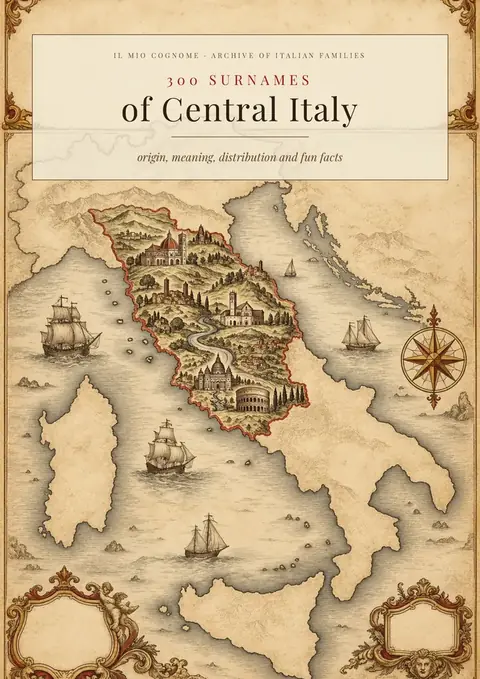 Surnames of Central Italy
From the blog: The Surnames of Italy’s Foundlings, from Esposito to Proietti
Surnames of Florence
Instant PDF · 69 pages
What people say about us
A few of the more than 20,000 comments and messages you’ve left us.
Read all the reviews