
Surnames of Tuscany
origin, meaning, distribution and fun facts


€19.90 Instant PDF · 177 pages
Buy the volumeOne-time payment, no renewals · Secured by Stripe
- Instant PDF, and the link also arrives by email
- In Italian and English: you get both versions
- A4 format: read it on your phone or print it
Before Rome, Tuscany was the land of the Etruscans, and even its name comes from them: the Romans called them Tusci. Then came the Romans, the Lombards of Lucca, seafaring Pisa and the Florence of the guilds, and every story that passed through left something in the surnames. Cecchi, Vanni and Gori come from the shortened names of Tuscan fathers, Innocenti from the babies left at the foundling wheel in Florence.
300surnames
177pages
9history chapters
What’s inside
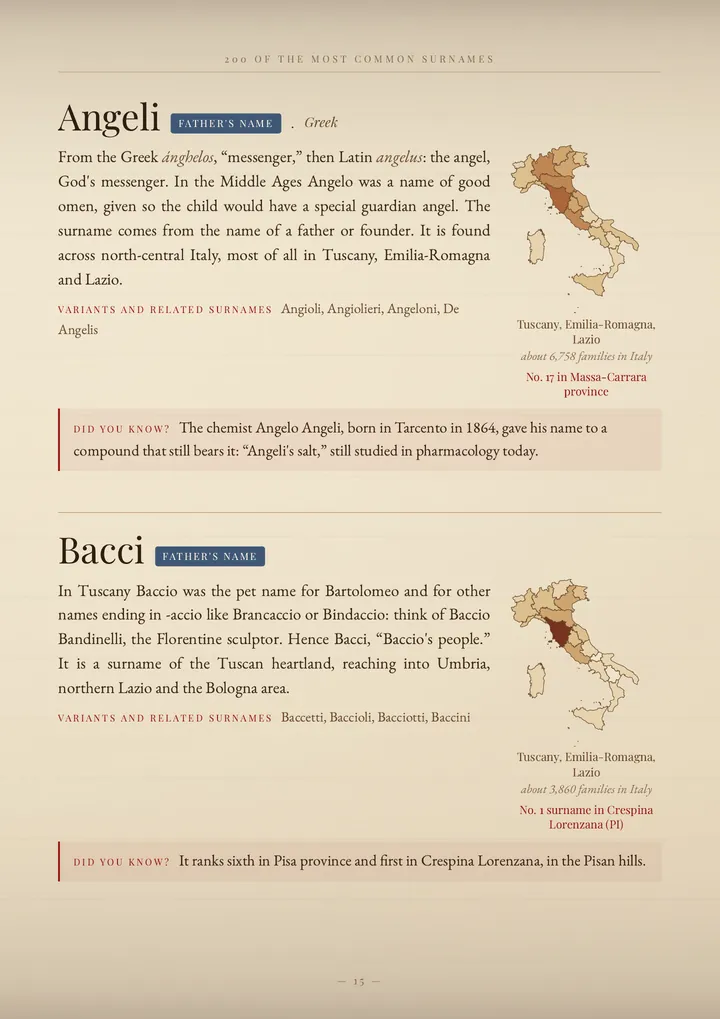
- For each surname, its origin, its meaning and the language it comes from, from Latin to the Germanic of the Lombards
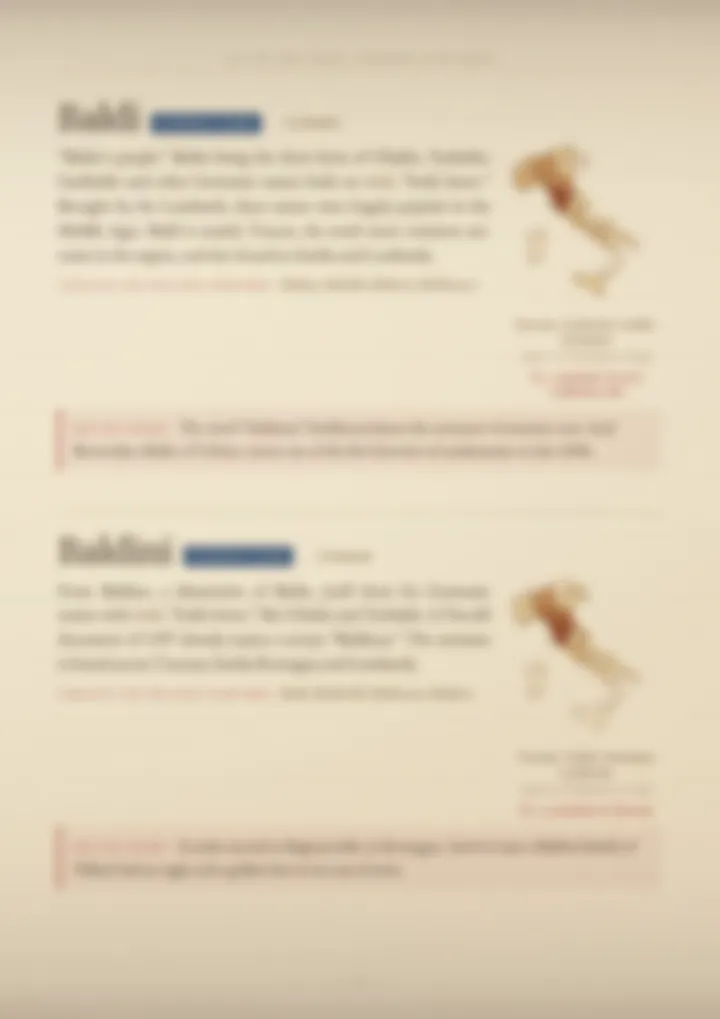
- The map of the Italian regions where it’s common today and an estimate of how many families carry it
- Where it stands in Tuscany, when the figure exists, meaning its rank in Tuscany or in the province, or the town where it ranks first
- The variants and related surnames, meaning the other forms and spellings of the same surname
- One fun fact per surname, from a town to a historical figure

Surnames of Tuscany
Tuscany’s surnames, people by people
Before the Romans, Tuscany was the land of the Etruscans, and even its name comes from them: the Romans called them Tusci and their land Tuscia. Their language died out almost two thousand years ago, but it lives on in place names, and places sometimes gave… continues in the volume
How to recognize a Tuscan surname
Some signs are easy to spot. In the workshops and streets nobody went by their full name: Francesco was Cecco, Giovanni was Vanni, Bartolomeo was Meo, Gregorio was Goro. From them come Cecchi, Vanni, Meoni and Gori, and more than half the surnames in this… continues in the volume
Province by province
At the back of the volume an index gathers the surnames most common in each province. There are 280 surnames from the book, spread across the ten provinces from Arezzo to Siena. Then comes the list of the 59 Tuscan towns where a surname from the book is the… continues in the volume
Is your surname in the volume?
Type it below: we'll tell you right away if it's there, and in which volume.
- Angeli
- Bacci
- Baglioni
- Bagnoli
- Baldi
- Baldini
- Ballerini
- Bandinelli
- Barni
- Baroncelli
- Baronti
- Barsotti
- Bartalucci
- Bartoli
- Bartolini
- Bartolozzi
- Bellandi
- Bellucci
- Bencini
- Benedetti
- Benelli
- Benvenuti
- Bernardini
- Berni
- Bertelli
- Berti
- Bertini
- Betti
- Biagi
- Biagini
- Biagioni
- Biagiotti
- Biancalani
- Bianchini
- Bigazzi
- Bindi
- Bini
- Biondi
- Boldrini
- Bonacchi
- Brizzi
- Brogi
- Bruni
- Buti
- Calamai
- Cambi
- Cantini
- Capecchi
- Cappelli
- Cappellini
- Carli
- Carmignani
- Casalini
- Casini
- Castellani
- Ceccherini
- Cecchi
- Cecchini
- Cecconi
- Cheli
- Chiti
- Ciampi
- Cini
- Cioni
- Cipriani
- Coli
- Coppini
- Corsi
- Degl’Innocenti
- Dei
- Dini
- Donati
- Donnini
- Ermini
- Favilli
- Fedi
- Ferrini
- Fiaschi
- Fontanelli
- Fontani
- Franceschi
- Francesconi
- Franci
- Francini
- Frediani
- Frosini
- Galeotti
- Galletti
- Gasperini
- Gelli
- Gemignani
- Giacomelli
- Giannelli
- Giannetti
- Giannini
- Giannoni
- Giannotti
- Giorgetti
- Giorgi
- Giovannelli
- Giovannetti
- Giuntini
- Giuntoli
- Giusti
- Gori
- Grazzini
- Guerrieri
- Guerrini
- Guidotti
- Innocenti
- Landi
- Landini
- Lari
- Lazzeri
- Lazzerini
- Lenzi
- Lippi
- Lorenzini
- Lotti
- Lucchesi
- Maffei
- Magrini
- Manetti
- Mannucci
- Marchi
- Marcucci
- Mariotti
- Martini
- Masi
- Masini
- Massai
- Matteucci
- Mazzanti
- Mazzei
- Meini
- Melani
- Menichetti
- Meoni
- Meucci
- Michelotti
- Migliorini
- Montagnani
- Morelli
- Morganti
- Mori
- Mugnai
- Mugnaini
- Nannini
- Nardi
- Nardini
- Natali
- Nesi
- Nesti
- Nocentini
- Pacini
- Pagliai
- Pagni
- Panichi
- Paoletti
- Paoli
- Paolini
- Papi
- Papini
- Pardini
- Parigi
- Parri
- Parrini
- Pasquini
- Pellegrini
- Peruzzi
- Petri
- Picchi
- Piccini
- Pieri
- Pierini
- Pieroni
- Pistolesi
- Pratesi
- Pucci
- Puccini
- Raffaelli
- Ristori
- Romoli
- Rosi
- Salvadori
- Salvini
- Santini
- Senesi
- Signorini
- Simoncini
- Stefanini
- Tani
- Tesi
- Turchi
- Vanni
- Vannini
- Vannucchi
- Vannucci
- Vettori
- Viti
- Acciai
- Aiazzi
- Ammannati
- Badii
- Baglini
- Baldanzi
- Banti
- Barbagli
- Bardazzi
- Barsacchi
- Bartalesi
- Bartali
- Bartalini
- Becagli
- Becattini
- Bechelli
- Bechini
- Becucci
- Belluomini
- Bertelloni
- Bertocchini
- Bettarini
- Bigiarini
- Bimbi
- Bonciani
- Bonuccelli
- Borgioli
- Bracaloni
- Bracciali
- Calonaci
- Campigli
- Casarosa
- Ceccanti
- Ceccatelli
- Cellai
- Cencini
- Cherici
- Chiarugi
- Ciabatti
- Ciappi
- Citi
- Ciurli
- Cresti
- Demi
- Doveri
- Failli
- Falorni
- Fantacci
- Fantechi
- Federighi
- Focardi
- Fornai
- Francalanci
- Fruzzetti
- Fulceri
- Gabbrielli
- Gennai
- Giannecchini
- Gorelli
- Gronchi
- Guarducci
- Guazzini
- Lapini
- Lascialfari
- Lastrucci
- Lencioni
- Leporatti
- Macelloni
- Magnolfi
- Mannari
- Marinai
- Marradi
- Matteoli
- Mazzuoli
- Meacci
- Menci
- Messeri
- Moncini
- Mosti
- Nistri
- Palagi
- Pianigiani
- Pinzauti
- Profeti
- Puccinelli
- Puccioni
- Ramacciotti
- Rigacci
- Risaliti
- Sampieri
- Sbrana
- Sestini
- Simi
- Tarchi
- Tavanti
- Tuci
- Ulivieri
- Verdiani
- Vignozzi
- Volterrani
The 10 most common surnames, in short
What they mean, in one sentence. The rest of the story is in the volume, and every surname has its own booklet.
- Martini
“Martino’s family,” from Saint Martin, the soldier who shared his cloak with a beggar.
The full story of the Martini surname →- Pellegrini
From the Latin peregrinus, “foreigner, stranger”: at first someone from elsewhere, then someone who had made a pilgrimage to Rome, Santiago or the Holy Land.
The full story of the Pellegrini surname →- Benedetti
From the Christian name Benedictus, “blessed,” a wish turned into a name.
The full story of the Benedetti surname →- Morelli
From Morello, a diminutive of Moro, from the Latin Maurus: it meant someone with dark skin or hair.
The full story of the Morelli surname →- Marchi
“Marco’s family.” From the Latin Marcus, linked to Mars; in the Middle Ages it spread with devotion to Saint Mark the Evangelist.
The full story of the Marchi surname →- Giorgi
From Giorgio, from the Greek gheorgós, “farmer, worker of the land.”
The full story of the Giorgi surname →- Donati
From Donato, a name of good omen: the child “given” by God.
The full story of the Donati surname →- Bruni
From Bruno, a medieval name that began as a nickname for someone with dark hair or skin.
The full story of the Bruni surname →- Santini
From Santino, a diminutive of Santo: a devotional name, often given to babies born on All Saints’ Day.
The full story of the Santini surname →- Innocenti
The surname of abandoned children. From 1445 the babies left at Florence’s Spedale degli Innocenti were registered under this name, after the Holy Innocents killed by Herod.
The full story of the Innocenti surname →
Frequently asked questions
Is my surname in the volume?
The full list of the 300 surnames is on this page. The full story of your surname, written for you, is in the €9.50 booklet on the “Your surname story” page.
How is it different from the volume on Central Italy?
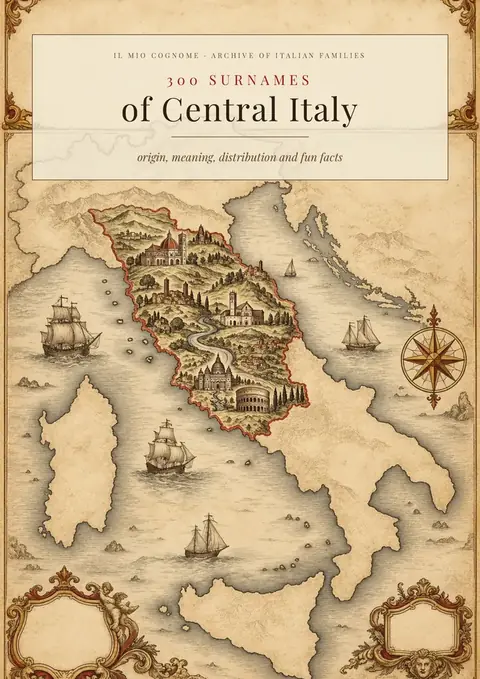
The Central Italy volume picks 300 surnames from four regions. This one is devoted to Tuscany alone: nine chapters on the region’s peoples and stories and, when there is one, the place in Tuscany where each surname ranks highest. 121 surnames are in both: the other 179 you’ll find only here.
Will I find the surnames of my province?
At the back of the volume an index gathers the surnames most common in each province. There are 280 surnames from the book, spread across the ten provinces, not just Florence. There’s also the list of the 59 Tuscan towns where a surname from the book is the most common.
What’s the difference between the volume and a surname booklet?
In the volume each surname has a half-page entry: origin, map, variants and a fun fact. The booklet is devoted to a single surname and tells its story, its towns and its distribution in 12-19 pages. It also has a family tree and a surname scroll personalized with that surname.
Does the volume tell me who my ancestors were?
No. A surname tells you where a word comes from, and two families with the same surname can have completely different stories. At the back of the volume there’s a guide to searching for your ancestors in the archives, free and from home. It includes tips for Tuscany, where civil registration predates Unification: it arrived with Napoleon in 1808 and went on in the Grand Duchy’s registers until 1865.
Does the volume include my surname’s coat of arms?
No, because a surname has no coat of arms. A coat of arms belonged to one specific branch of a family, not to everyone who carries the surname. When a fun fact mentions one, the entry says which family it belonged to.
What if scholars disagree about the origin?
We tell you. When an origin is certain, it’s written as certain. When it isn’t, the entry carries the gray “disputed origin” badge and gives you the theories.
Can I print it?
Yes, for personal and family use: you can print it for yourself and your relatives.
More volumes from the area
 Surnames of Florence
 Surnames of Central Italy
Surnames of Tuscany
Instant PDF · 177 pages
What people say about us
A few of the more than 20,000 comments and messages you’ve left us.
Read all the reviews