
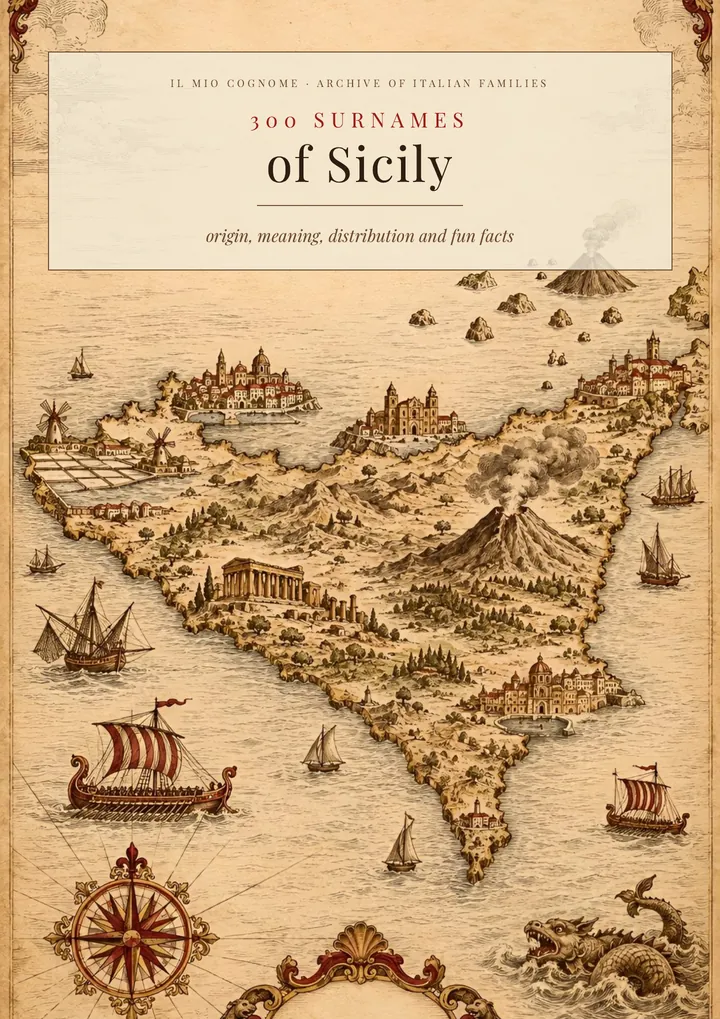
Surnames of Sicily
origin, meaning, distribution and fun facts

€19.90 Instant PDF · 179 pages
Buy the volumeOne-time payment, no renewals · Secured by Stripe
- Instant PDF, and the link also arrives by email
- In Italian and English: you get both versions
- A4 format: read it on your phone or print it
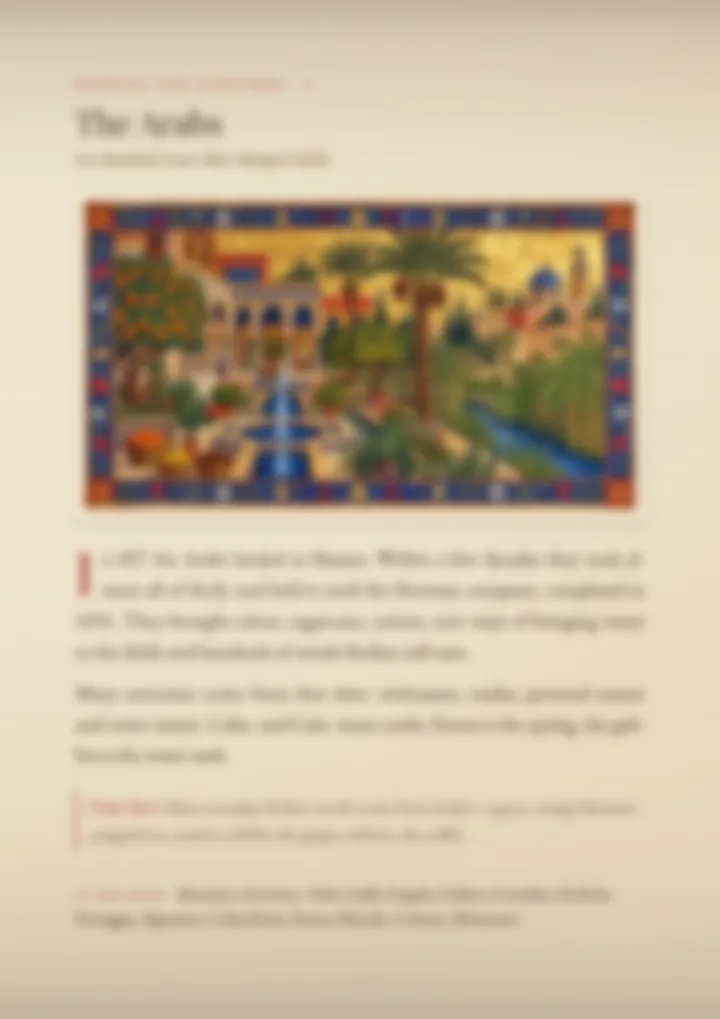
Sicily has been Greek, Byzantine, Arab, Norman, Swabian, Aragonese and Spanish, and every people that passed through left something in the island’s surnames. Some surnames are Greek words, others come from Arabic, others still are the names of cities: Messina, Catania, Palermo, Trapani.
300surnames
179pages
11history chapters
What’s inside
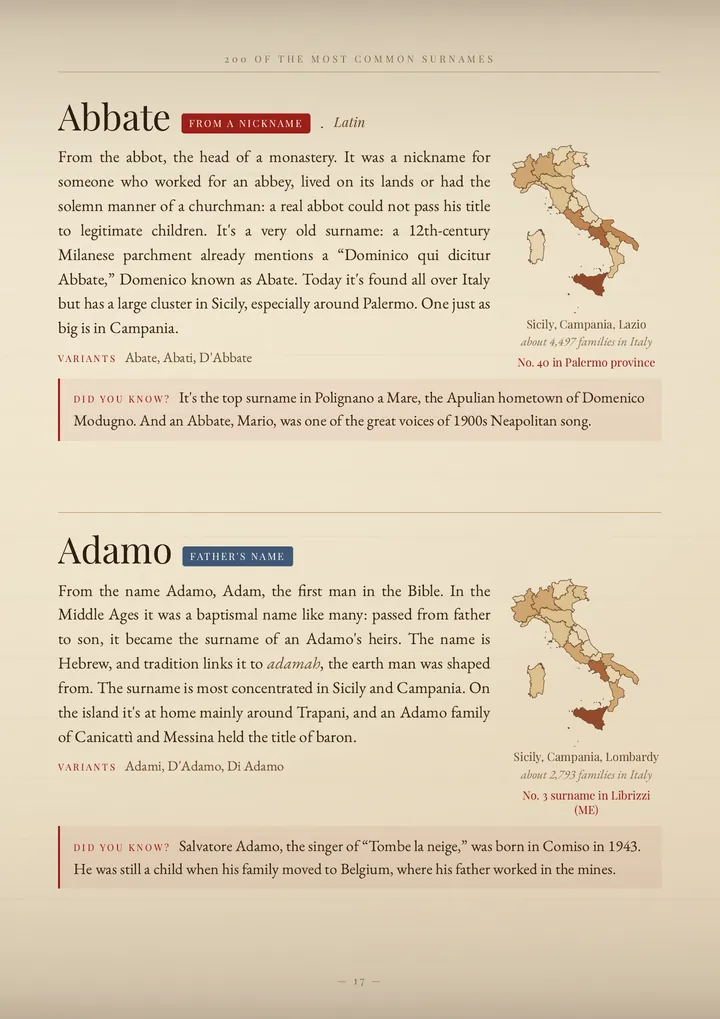
- For each surname, its origin, its meaning and the language it comes from, from Greek to Arabic
- The map of the Italian regions where it’s common today and an estimate of how many families carry it
- The Sicilian record, when there is one, meaning the surname’s rank or the town where it’s No. 1
- The variants, meaning the other forms and spellings of the same surname
- One fun fact per surname, from a town to a historical figure

Surnames of Sicily
Sicily’s surnames, people by people
In 734 BC the Greeks founded Naxos, below Taormina, and for more than a thousand years Greek remained the language of church and village. From there come surnames that are names of cities, saints and trades: Trapani, for example, comes from drépanon, the… continues in the volume
How to recognize a Sicilian surname
Some signs are easy to spot. The article in front, Lo, La, Li, is typical of the island: Lo Presti, La Rosa, Lo Giudice. Di means “son of”: Di Stefano, Di Mauro. The accent at the end, as in Calì, Patanè and Zappalà, is often a clue to a Greek or Arabic… continues in the volume
Province by province
At the back of the volume an index gathers, province by province, the surnames most common there: 197 surnames from the book, spread across the nine provinces from Agrigento to Trapani. Then comes the list of the 77 Sicilian towns where a surname from the… continues in the volume
Is your surname in the volume?
Type it below: we'll tell you right away if it's there, and in which volume.
- Abbate
- Adamo
- Agnello
- Agosta
- Aiello
- Alaimo
- Alessi
- Amato
- Arcidiacono
- Arena
- Barbagallo
- Barbera
- Barone
- Basile
- Battaglia
- Biondo
- Bonanno
- Bono
- Bruno
- Burgio
- Calabrese
- Calì
- Cammarata
- Campisi
- Campo
- Cannata
- Cannizzaro
- Cappello
- Caruso
- Cascio
- Castiglione
- Catalano
- Catania
- Cavallaro
- Cicero
- Coco
- Consoli
- Conti
- Cosentino
- Costa
- Costantino
- Costanzo
- Cottone
- Cusumano
- D’Amico
- D’Angelo
- D’Anna
- De Luca
- Di Bella
- Di Benedetto
- Di Dio
- Di Gregorio
- Di Maggio
- Di Marco
- Di Maria
- Di Martino
- Di Mauro
- Di Pietro
- Di Salvo
- Di Stefano
- Drago
- Failla
- Fazio
- Ferrante
- Ferrara
- Ferraro
- Ferro
- Fichera
- Finocchiaro
- Fontana
- Foti
- Furnari
- Gagliano
- Gallo
- Garofalo
- Genovese
- Gentile
- Geraci
- Giacalone
- Giannone
- Giardina
- Giordano
- Giuffrida
- Giuliano
- Giunta
- Grasso
- Greco
- Grillo
- Gulino
- Iacono
- Indelicato
- La Barbera
- Lanza
- La Rocca
- La Rosa
- Lentini
- Leonardi
- Leone
- Leotta
- Licata
- Licciardello
- Lipari
- Lo Giudice
- Lombardo
- Longo
- Lo Presti
- Lupo
- Macaluso
- Maggio
- Maltese
- Mancuso
- Mangano
- Maniscalco
- Mannino
- Marchese
- Marino
- Marletta
- Martorana
- Maugeri
- Mazzola
- Meli
- Messina
- Miceli
- Migliore
- Milazzo
- Militello
- Mineo
- Modica
- Montalbano
- Motta
- Musumeci
- Napoli
- Occhipinti
- Orlando
- Pace
- Pagano
- Palazzolo
- Palermo
- Palmeri
- Palumbo
- Pappalardo
- Parisi
- Patanè
- Patti
- Pecoraro
- Pellegrino
- Pennisi
- Petralia
- Piazza
- Pipitone
- Pizzo
- Platania
- Polizzi
- Privitera
- Puccio
- Puglisi
- Pulvirenti
- Raciti
- Ragusa
- Randazzo
- Rapisarda
- Rizza
- Rizzo
- Romano
- Romeo
- Rubino
- Ruggeri
- Russo
- Salemi
- Salvo
- Sanfilippo
- Santangelo
- Santoro
- Sapienza
- Schillaci
- Sciacca
- Sciortino
- Scuderi
- Sorbello
- Sottile
- Spadaro
- Spampinato
- Spina
- Strano
- Terranova
- Todaro
- Torre
- Torrisi
- Toscano
- Trapani
- Urso
- Vaccaro
- Valenti
- Vassallo
- Vecchio
- Vella
- Ventura
- Vinci
- Vitale
- Zappalà
- Abbruzzo
- Accetta
- Agate
- Agugliaro
- Alescio
- Algozzino
- Alosi
- Aquilina
- Arcoleo
- Attardo
- Avola
- Badalamenti
- Baglio
- Blandini
- Blunda
- Bongiovi
- Buemi
- Cafari
- Caico
- Calandrino
- Calascibetta
- Caldarella
- Cancemi
- Cardaci
- Carrubba
- Casablanca
- Cassisi
- Castriciano
- Catalfamo
- Catanese
- Ciurcina
- Colletti
- Cristodaro
- Curatolo
- Dino
- Di Noto
- Donia
- Enea
- Farruggia
- Favara
- Fiandaca
- Fiorello
- Fragalà
- Fricano
- Galifi
- Gambina
- Gangi
- Gebbia
- Geloso
- Gemellaro
- Giaramita
- Giarratano
- Graci
- Granvillano
- Guttuso
- Incorvaia
- Indovino
- Ingraffia
- La Greca
- Latina
- Leggio
- Levantino
- Liberto
- Lo Castro
- Lo Cicero
- Lo Nardo
- Lumia
- Maiorca
- Mallo
- Mangiapane
- Marsala
- Pizzurro
- Pluchino
- Prestifilippo
- Prestigiovanni
- Provenzani
- Ravì
- Realmuto
- Rindone
- Salvia
- Sanclemente
- Sciarratta
- Scicolone
- Sclafani
- Seidita
- Solarino
- Spiteri
- Stornello
- Sturiale
- Taibi
- Tirenni
- Trusso
- Turdo
- Tusa
- Tuttobene
- Vigneri
- Virga
- Viscuso
- Zambuto
- Zichichi
The 10 most common surnames, in short
What they mean, in one sentence. The rest of the story is in the volume, and every surname has its own booklet.
- Marino
From the Latin name Marinus, “man of the sea.”
The full story of the Marino surname →- Costa
From the Latin costa, “side”: the side of a mountain, the bank of a river, the shoreline.
The full story of the Costa surname →- Rizzo
It’s “riccio,” curly, in dialect: the nickname of someone with curly or spiky hair, or a prickly character.
The full story of the Rizzo surname →- Caruso
In Sicilian carusu means “boy,” the errand boy.
The full story of the Caruso surname →- Lombardo
In Sicily “Lombards” were not just the Milanese: the name was used for settlers who came from northern Italy with the Normans, in the 11th to 13th centuries, from Piedmont, Liguria and Emilia.
The full story of the Lombardo surname →- Messina
From the city of Messina, whose name comes from the Greek Messéne.
The full story of the Messina surname →- Parisi
Several theories: from Paris, for someone with ties to France; from the Gallic tribe of the Parisii; or from Paris, the Trojan prince of myth. The surname is found mostly in the South, with its heart in Sicily.
The full story of the Parisi surname →- Pellegrino
From the Latin peregrinus, “foreigner, stranger”: originally someone from elsewhere.
The full story of the Pellegrino surname →- Piazza
From the piazza, the heart of town life: it could be the nickname of someone who lived there or sold goods there.
The full story of the Piazza surname →- Orlando
From the Germanic name Hruodland, “famous for his glory,” made immortal by Charlemagne’s paladin.
The full story of the Orlando surname →
Frequently asked questions
Is my surname in the volume?
The full list of the 300 surnames is on this page. The full story of your surname, written for you, is in the €9.50 booklet on the “Your surname story” page.
How is it different from the volume on the South and the Islands?
The South volume picks 300 surnames from eight regions. This one is devoted to Sicily alone: eleven chapters on the island’s peoples and stories and, when there is one, each surname’s Sicilian record. 151 surnames are in both: the other 149 you’ll find only here.
Will I find the surnames of my province?
At the back of the volume an index gathers, province by province, the surnames most common there: 197 surnames from the book, spread across the nine provinces from Agrigento to Trapani. There’s also the list of the 77 Sicilian towns where a surname from the book is the most common.
What’s the difference between the volume and a surname booklet?
In the volume each surname has a half-page entry: origin, map, variants and a fun fact. The booklet is devoted to a single surname and tells its story, its towns and its distribution in 12-19 pages, with a family tree and a surname scroll personalized with that surname.
Does the volume tell me who my ancestors were?
No. A surname tells you where a word comes from, and two families with the same surname can have completely different stories. At the back of the volume there’s a guide to start searching for your ancestors in the archives, free and from home, with tips for Sicily, where civil registration began in 1820.
Does the volume include my surname’s coat of arms?
No, because a surname has no coat of arms: a coat of arms belonged to one specific branch of a family, not to everyone who carries the surname. When a fun fact mentions one, the entry says which family it belonged to.
What if scholars disagree about the origin?
We tell you. When an origin is certain, it’s written as certain; when it isn’t, the entry carries the gray “disputed origin” badge and gives you the theories.
Can I print it?
Yes, for personal and family use: you can print it for yourself and your relatives.
More volumes from the area
 Surnames of Sicily · Volume 2
300 surnames
 Surnames of Catania
100 surnames
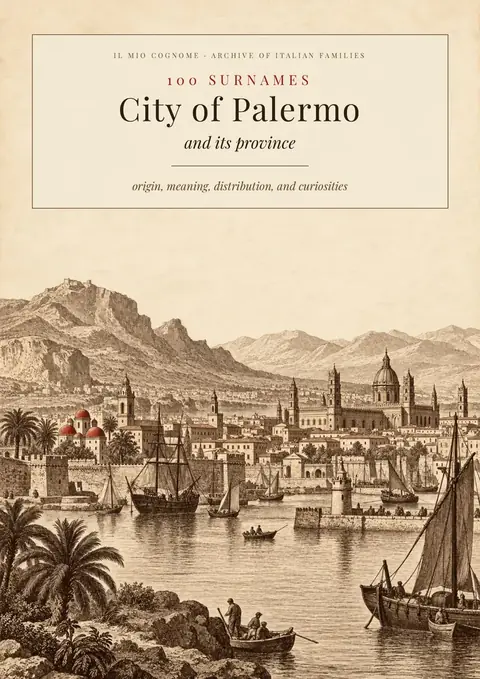 Surnames of Palermo
100 surnames
 Surnames of Messina
100 surnames
 Surnames of Trapani
100 surnames
 Surnames of Agrigento
100 surnames
 Surnames of Siracusa
100 surnames
 Surnames of the South and the Islands
300 surnames
From the blog: Was Your Family’s Name Changed at Ellis Island? · How to Find Your Italian Ancestors on the Portale Antenati · Sicilian Surnames and Where They Come From
Surnames of Sicily
Instant PDF · 179 pages
What people say about us
A few of the more than 20,000 comments and messages you’ve left us.
Read all the reviews